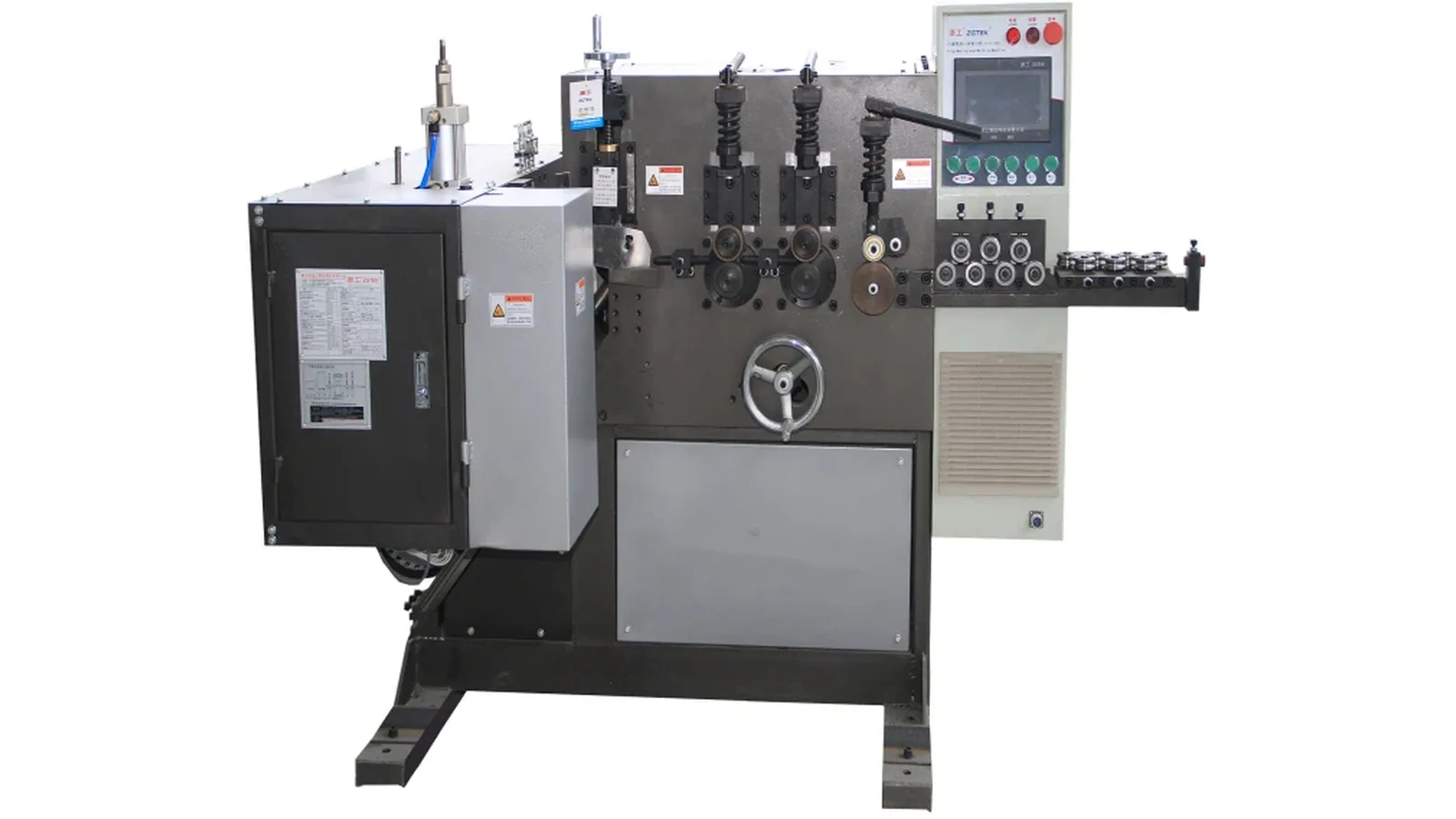
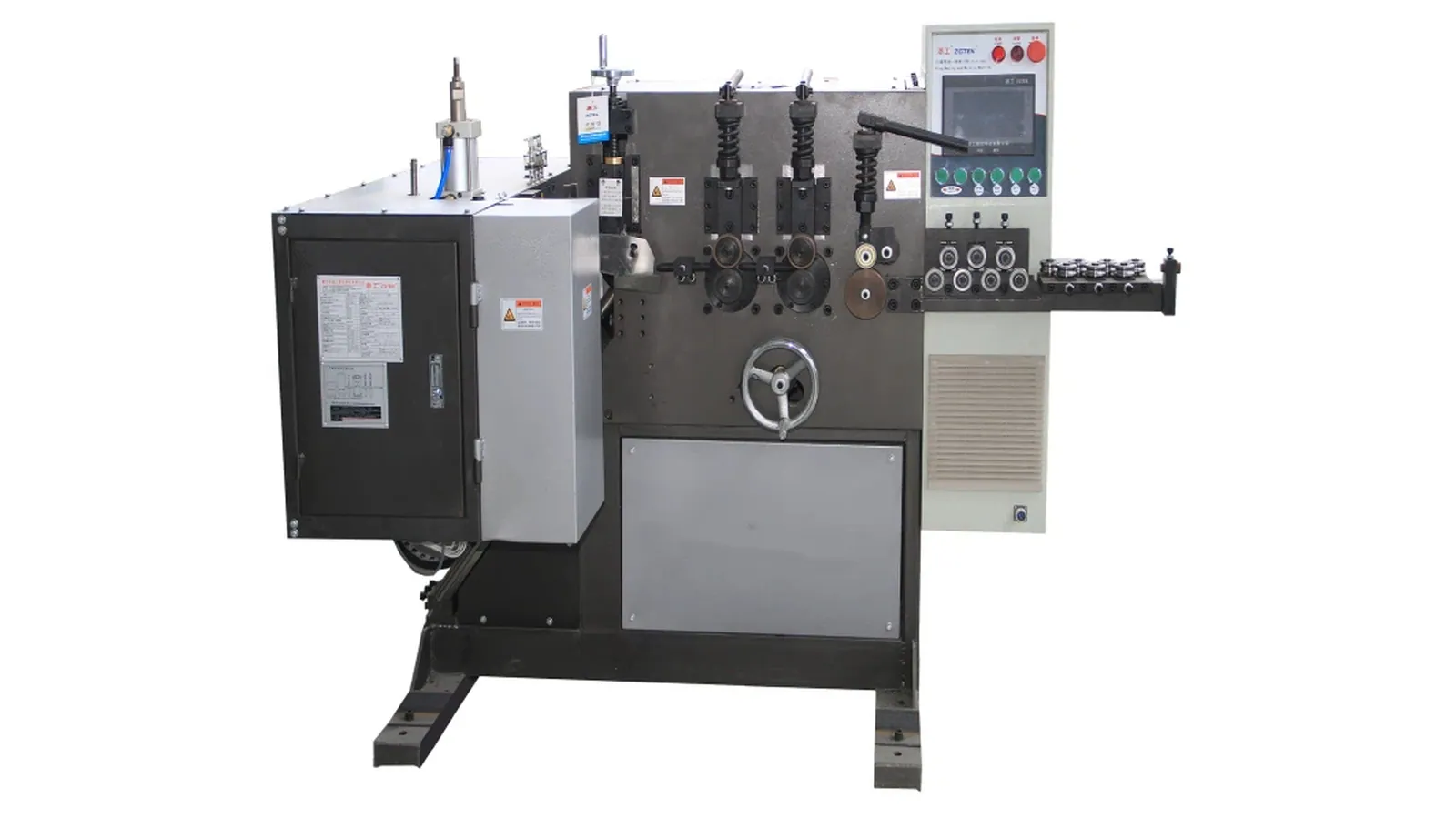
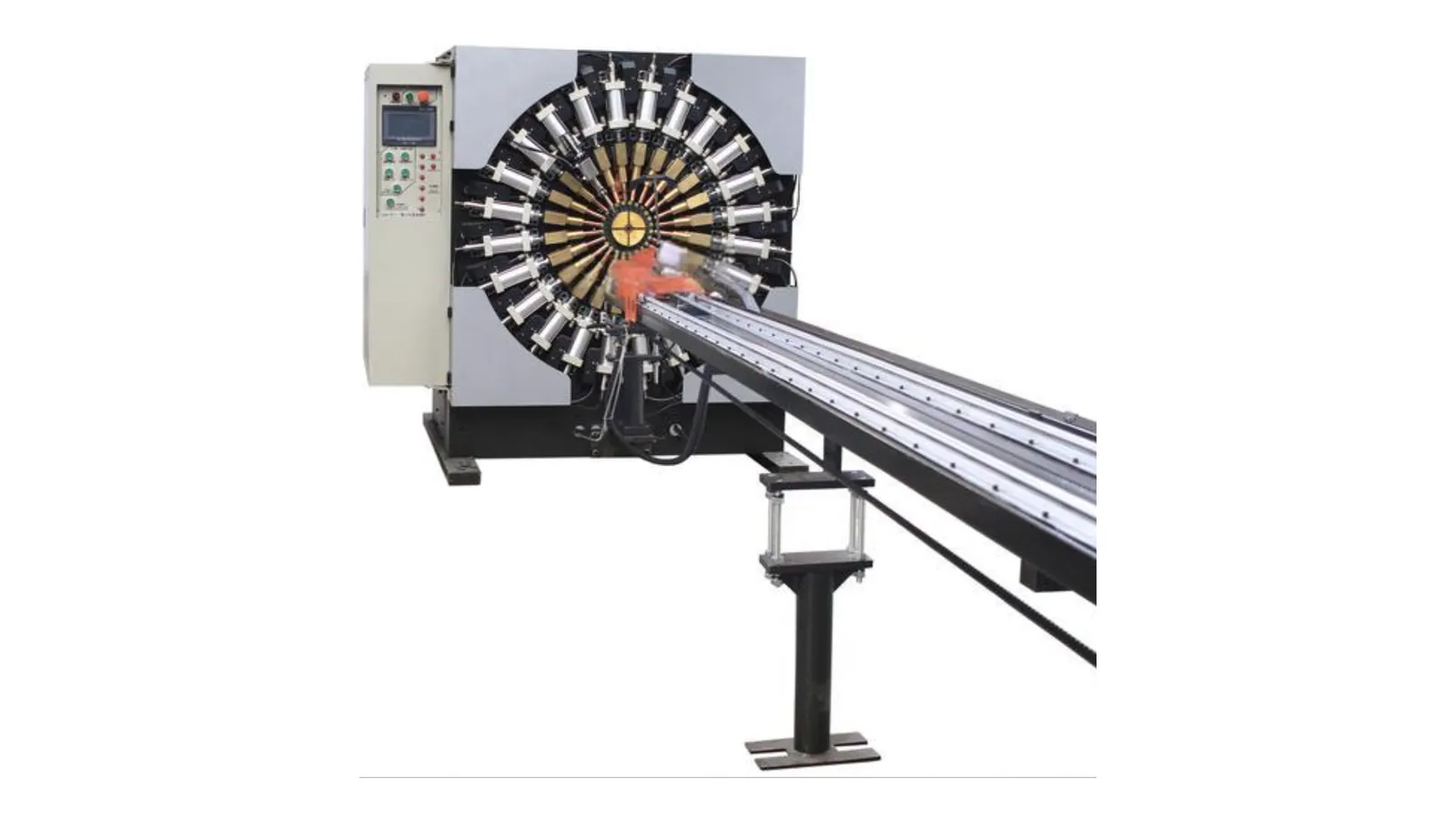
Wire in, welded ring out — in one continuous cycle. This machine bends 2–5 mm wire into a ring and butt-welds the closed loop automatically, so a ring leaves the machine ready to use rather than waiting for a second welding step. Wire feeding is a fully closed loop: a rotary encoder and the servo motor's own encoder correct the feed in real time, holding diameter error under 0.16 mm — the accuracy problem that mechanical and hydraulic forming machines cannot solve. There are no gears or pulleys in the feed path, so nothing wears into a tolerance. One operator sets the wire size on a scaled handwheel, the rest on the touch screen.

Wire size, ring diameter and output decide the configuration. Send us the wire material and ring sizes you run — we confirm the feed rolls, welding transformer and coil range on the proforma invoice.
| Wire diameter | 2–5 mm |
| Maximum coil diameter | 300 mm (up to 500 mm on custom order) |
| Minimum coil diameter | 70 mm |
| Output | Approximately 1560 pieces per hour for 150 mm diameter rings |
| Input voltage | 380 V (2-phase) |
| Grid frequency | 50 Hz |
| Transformer design power | 40 kVA |
| Instantaneous welding power | 15 kVA at 4 mm wire |
| Power during wire feeding | 2 kVA |
| Cooling method | Natural cooling |
| Air consumption | 250 L/min |
| Air source pressure | 0.6–0.8 MPa |
| Diameter accuracy | Error < 0.16 mm, closed-loop wire feed |
| Welding materials | Low-carbon, medium/high-carbon, spring steel, galvanized iron wire |
| Operation | Wire size by scaled handwheel; other parameters on the touch screen |
* Specifications as supplied for this model. Final configuration confirmed on the proforma invoice.
Full data on the forming head, the closed-loop feed, the welding transformer and the pneumatics.
Ring formed and butt-welded in one automatic cycle
| Function | Wire ring forming plus automatic butt welding |
| Wire diameter | 2–5 mm |
| Coil diameter | 70–300 mm; up to 500 mm custom |
| Output | ≈1560 pcs/h at 150 mm ring |
| Welding | Automatic, no manual intervention |
| Materials | Low-carbon, medium/high-carbon, spring steel, galvanized iron wire |
Fully closed loop, no gears or pulleys
| Drive | Two motors directly driving the feed |
| Feedback | Rotary encoder + servo motor encoder, fully closed loop |
| Diameter error | < 0.16 mm |
| Speed curve | Intelligent S-shaped acceleration curve |
| Mechanical path | No gears or pulleys inside — no wear-induced accuracy loss |
| Wire size setting | Handwheel with a scale, plus touch-screen parameters |
40 kVA transformer, natural cooling
| Input voltage | 380 V (2-phase) |
| Grid frequency | 50 Hz |
| Transformer design power | 40 kVA |
| Welding instantaneous power | 15 kVA at 4 mm wire |
| Wire-feeding power | 2 kVA |
| Cooling | Natural cooling |
Air for clamping and cutting
| Air consumption | 250 L/min |
| Air pressure | 0.6–0.8 MPa at point of use |
| Preparation | Filtered, dry air; regulator at the machine |
PLC with touch screen, handwheel for wire size
| Controller | PLC with touch-screen HMI |
| Wire size | Scaled handwheel adjustment |
| Parameters | Feed length, speed and welding settings on screen |
| Changeover | Wire size change is a mechanical handwheel setting plus a recipe |
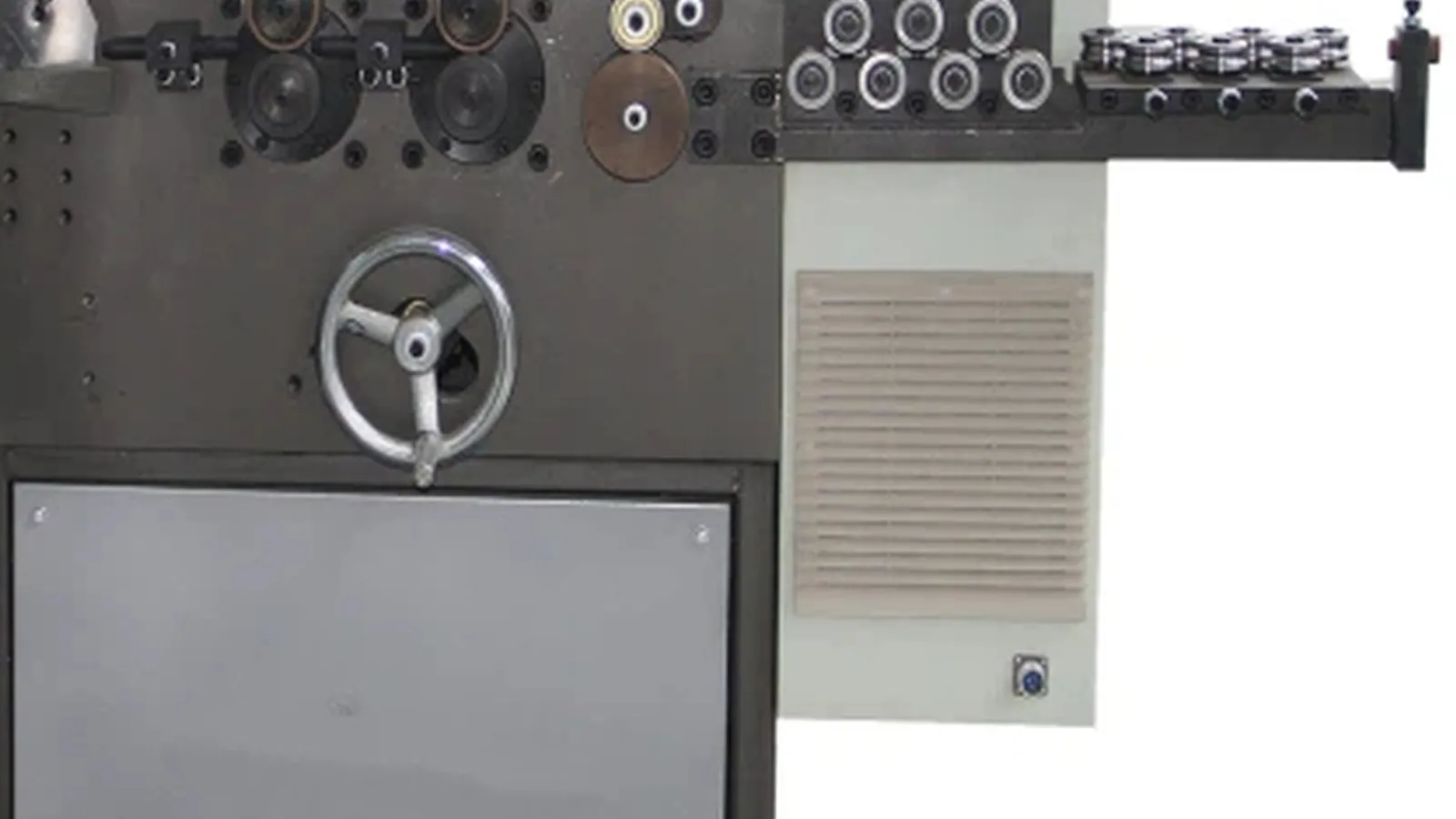
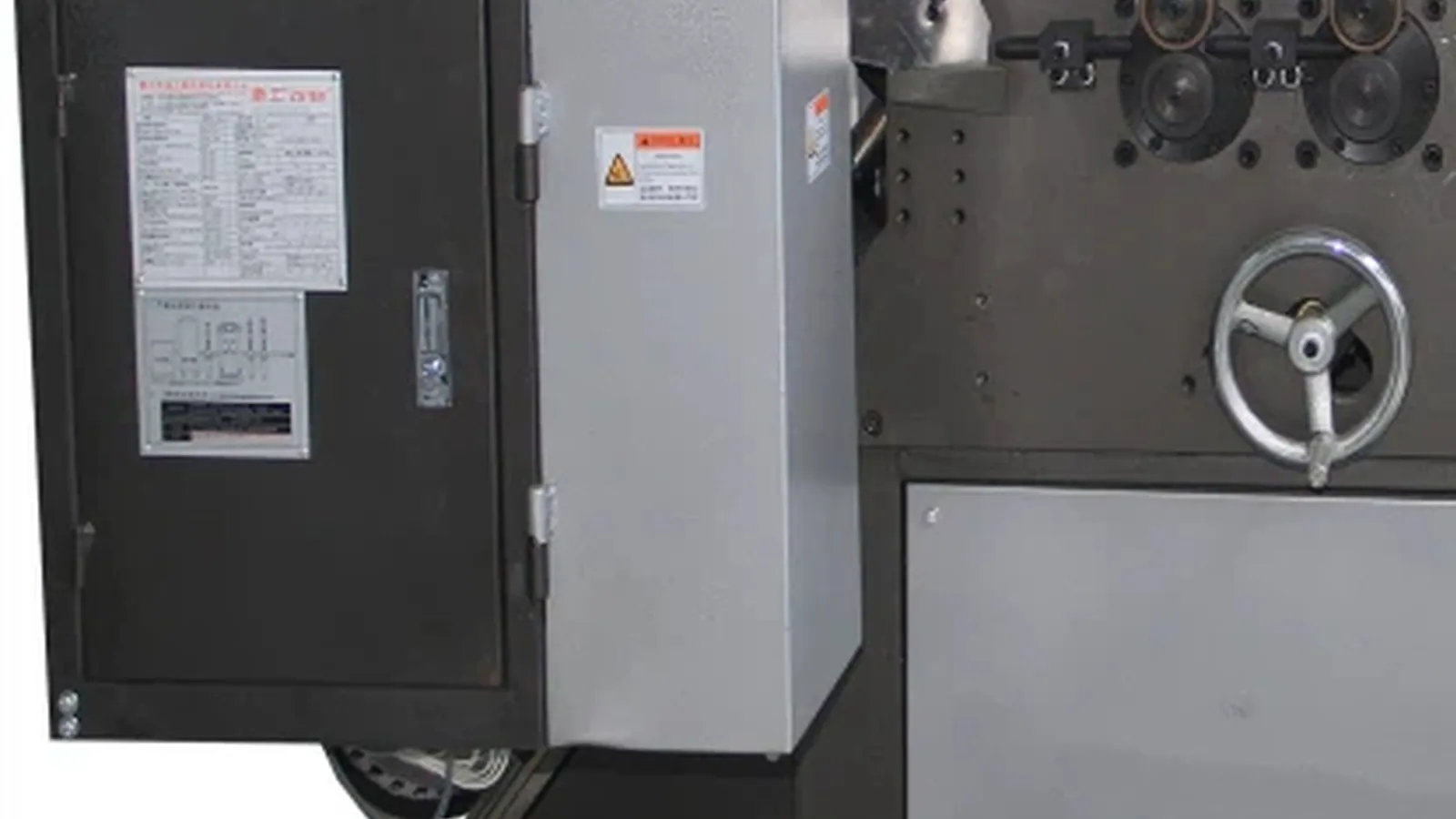
The forming head, feed rolls and control panel — the parts that decide ring accuracy.


Why ring accuracy is a control problem, and what this machine does about it.
A rotary encoder and the servo encoder close the loop on every revolution, so the ring diameter is corrected continuously. That is why the error stays under 0.16 mm instead of drifting as the coil or the wire changes.
Two motors drive the wire directly. With no gear train or belt in the feed, there is nothing to wear into a tolerance, so accuracy at 10,000 pieces matches accuracy at the first piece.
The ring is welded as part of the same cycle, so the loop closes before it can spring open. There is no second machine, no second operator, no handling of open rings.
Wire size is set on a scaled handwheel and confirmed on the touch screen. Change from 3 mm to 4 mm wire without changing gear sets.
Low-carbon, medium and high-carbon, spring steel and galvanized wire all run on the same machine — the welding parameters change, not the tooling.
Where welded wire rings are a component rather than a craft item.
Power, air and floor space — plus what ships with the machine.
| Input voltage | 380 V (2-phase) |
| Grid frequency | 50 Hz |
| Transformer design power | 40 kVA |
| Compressed air | 0.6–0.8 MPa, 250 L/min |
| Air quality | Filtered and dry; regulator at the machine |
| Floor | Level floor, machine on anti-vibration feet |
| Working clearance | Wire coil stand space on the infeed side |
What wire product manufacturers ask before buying a ring forming machine.
Yes. Forming and butt welding are one automatic cycle; the ring leaves closed and welded, with no manual handling of an open loop between steps.
Diameter error stays under 0.16 mm. The feed is a fully closed loop using a rotary encoder and the servo motor encoder, correcting in real time rather than relying on a mechanical setting.
Low-carbon, medium and high-carbon steel, spring steel and galvanized iron wire. Each material gets its own welding setting, so switching material is a recipe change.
70–300 mm as standard, up to 500 mm on custom order, with wire from 2 to 5 mm. Tell us your range and we confirm tooling and the coil stand.
About 1560 pieces per hour on 150 mm rings. Larger rings take longer per piece; give us your size mix and we estimate the blended rate.
380 V 2-phase, 50 Hz with a 40 kVA transformer, and compressed air at 0.6–0.8 MPa with 250 L/min consumption.
Ring forming machines usually feed a cage or mesh line — these are the neighbours.

Cage body, head and bottom welding with the support rings this machine produces.

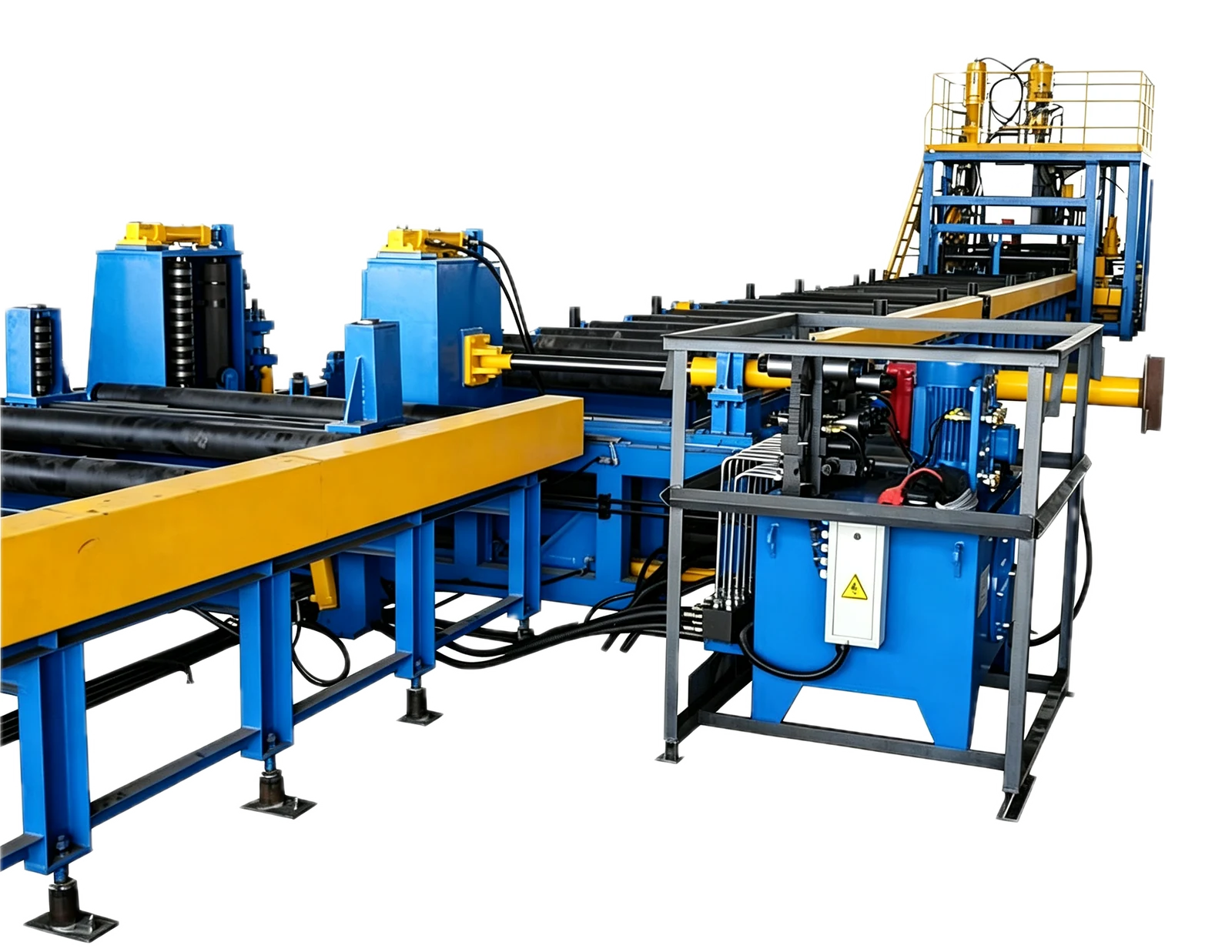
Automated fit-up and welding for H-beam sections feeding a structural shop.

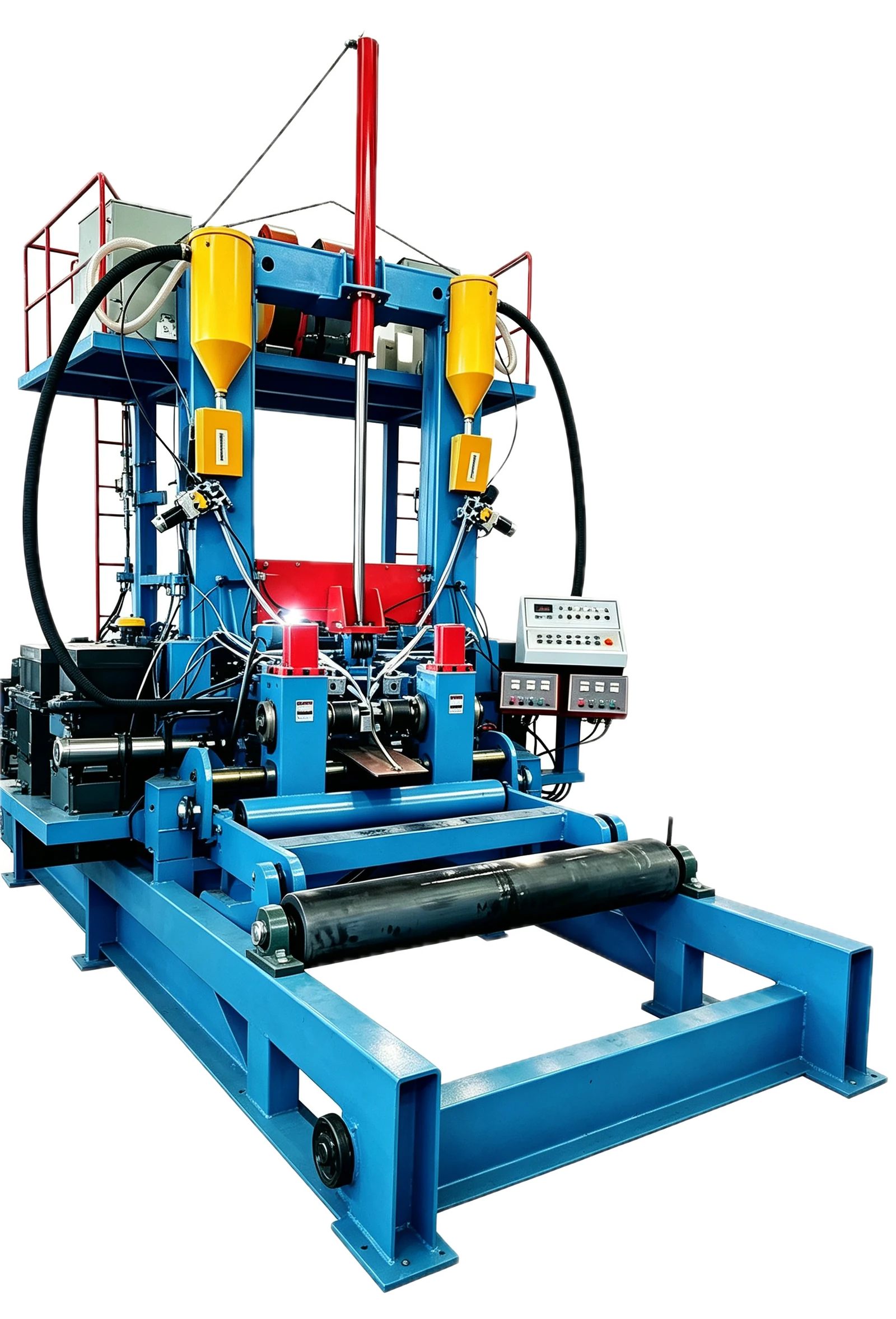
Fit-up, welding and straightening of H-beam sections in one station.
Wire diameter and material, ring diameters, pieces per shift and the air supply at your wall. An English-speaking engineer replies within one business day with tooling and output estimate.