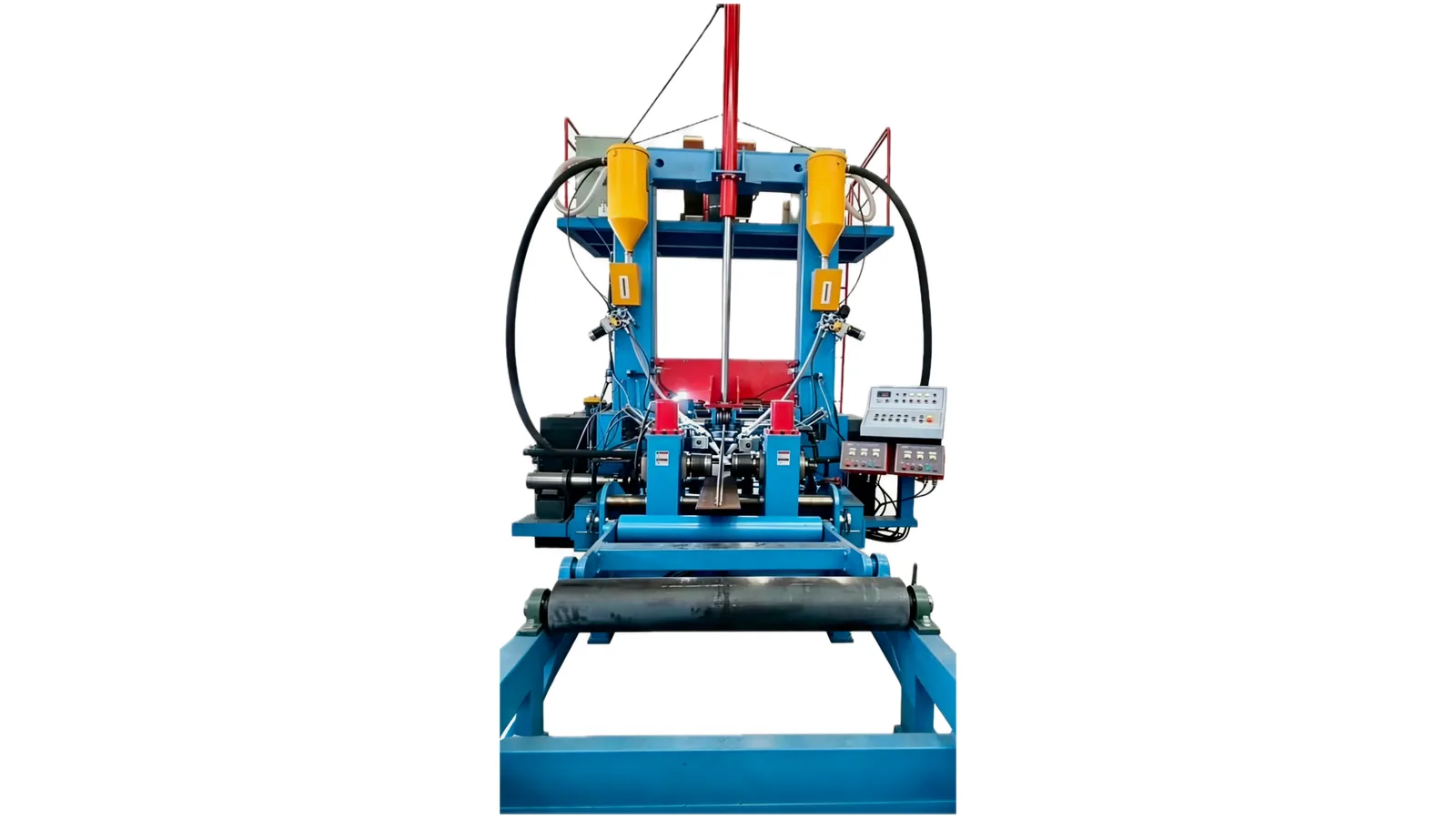
Fit-up, welding and straightening used to be three stations, three floor areas and three sets of handling. This machine does all three in one pass: the web and flange are hydraulically centred and clamped, a gantry press closes the gap between web and flange, a single-arc single-wire submerged arc torch welds the seam with flux recovered and re-fed, and hydraulic straightening rolls press the flange flat as the beam leaves the welding zone. One operator loads the section, the machine does the rest — which is how a beam shop gets the same output from a shorter line and fewer people.

Section size, plate thickness and welding speed decide the configuration. Send the beam schedule — web height, flange width, thickness and length — and we confirm the station layout and conveyor lengths on the proforma invoice.
| Web height | 150–1500 mm |
| Web thickness | 5–25 mm (from 14 mm the weld is sound but does not fully penetrate) |
| Flange width | 150–800 mm |
| Flange thickness | 6–30 mm |
| H-beam length | 4000–15000 mm |
| Welding speed | 350–1500 mm/min |
| Welding method | Single arc single wire submerged arc |
| Welding wire diameter | 3.2 or 4.0 mm |
| Web positioning | Hydraulic motor + gear and screw lead |
| Flange clamping | Hydraulic motor + gear and screw lead |
| Straightening | Hydraulic upper roller against chain-driven bottom roller |
| Input conveyor | 3 + 1 sets, two motorised |
| Output conveyor | 3 sets, two with hydraulic lift |
| Pull rod | 1 set, hydraulic |
| Hydraulic motor | 5.5 kW |
| Transmission motor | 4 kW |
| Conveyor motors | 1.1 kW × 2 |
| Flux recovery units | 3 kW × 2 |
| SAW welder power | 70 kVA × 2 |
| Voltage | AC 380 V, 50 Hz, 3 phase |
* Specifications as supplied for this model. Final configuration confirmed on the proforma invoice.
Machine by machine: frame and clamping, welding head, flux circuit, straightening unit, conveyors and drives.
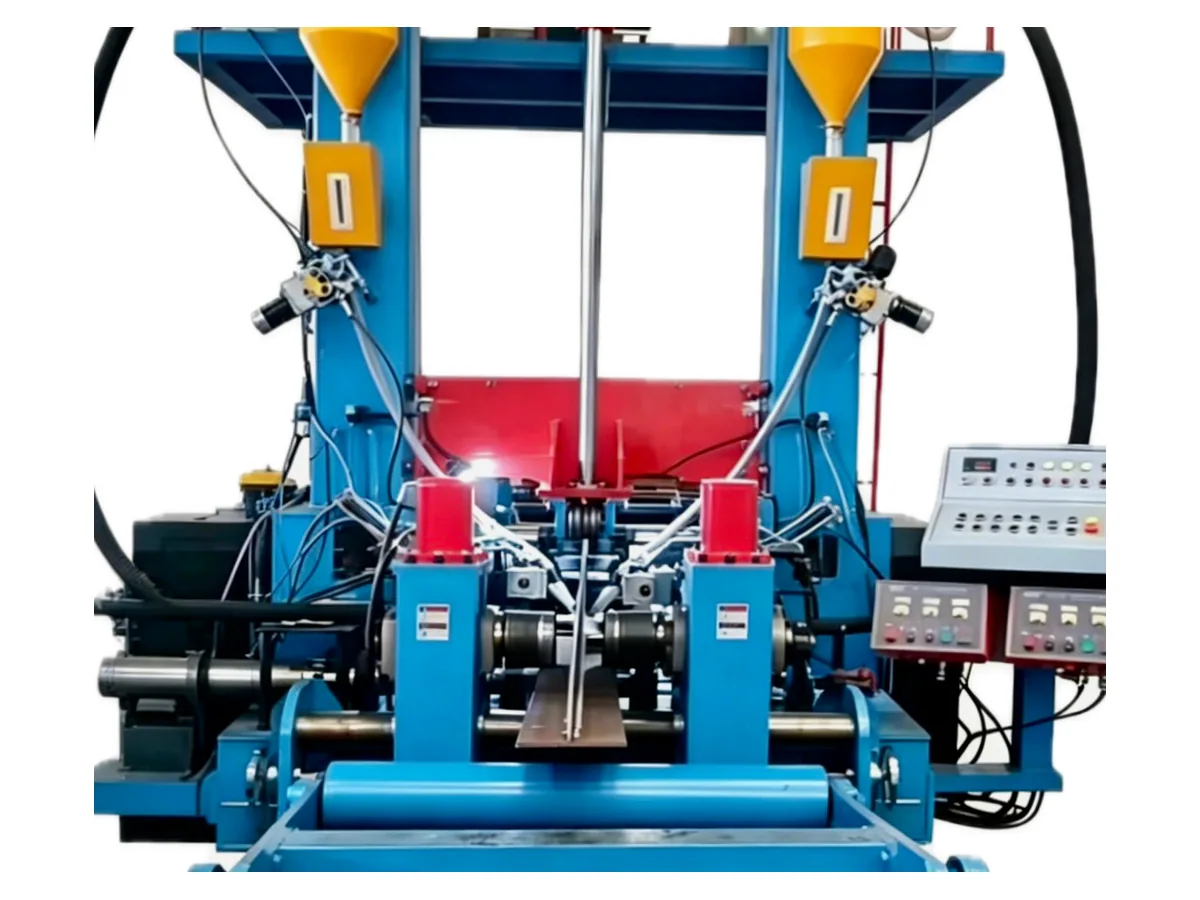
Hydraulically centred web and flange, gantry press on top
| Main frame | Welded from high-strength steel plate |
| Web centring | Hold rack, screw lead, hydraulic motor — automatic position and clamp |
| Flange centring | Clamp roller, guide slider, screw lead, hydraulic motor |
| End self-alignment | End device aligns the three plates before welding |
| Gantry press | Press wheel on a lift beam, cylinder-driven along guide rails, closes web-flange gap |
| Hydraulic pressure | Adjustable at the pump-station valves |
Single arc single wire, flux recovered and re-fed
| Welding method | Single arc single wire submerged arc |
| Wire diameter | 3.2 or 4.0 mm |
| Welding speed | 350–1500 mm/min |
| Torch positioning | Hydraulic cylinder pushes the movable shelf to the seam |
| Arc guide | Three-direction stepless torch angle adjustment |
| Flux system | Flux bucket, supply bucket, recovery machine, pipeline, valve, fan |
| Flux recovery power | 3 kW × 2 |
| Power sources | 2 × 70 kVA submerged arc welders with wire feeders |
Hydraulic top roller, driven bottom roller
| Upper roller | Hydraulically pushed down on the flange |
| Bottom roller | Chain-driven by the main machine, continuous correction |
| Flange centring | Adjustable left and right screw leads |
| Roller set | Left and right straightening rollers plus support and guide axes |
| Correction point | Beam straightened as it leaves the welding zone, no second handling |
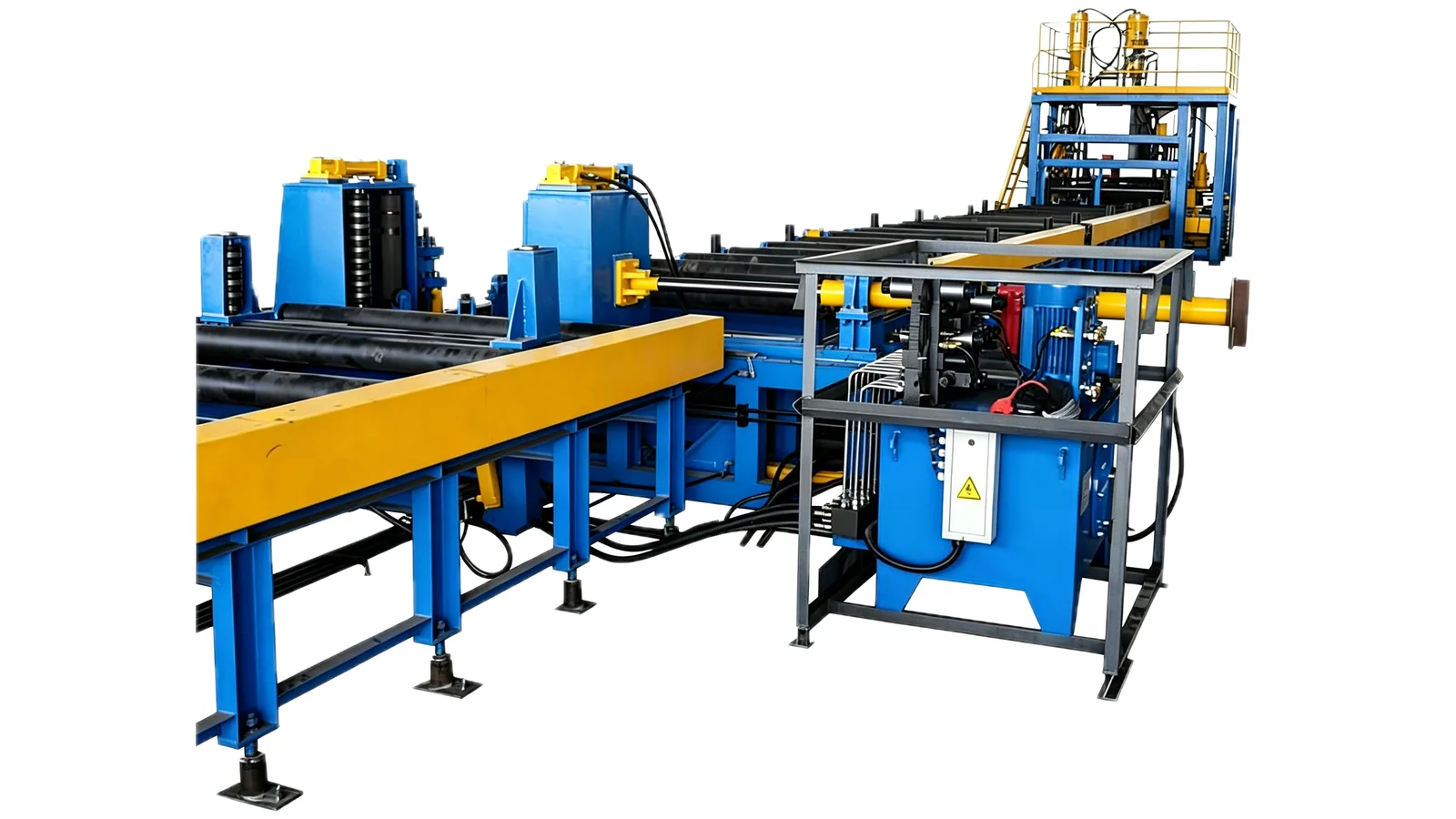
3 + 1 in, 3 out, chain driven
| Input conveyor | 3 + 1 sets, two motorised, 300–3000 mm/min feed |
| Output conveyor | 3 sets, two with hydraulic lift |
| Transmission | Motor and reducer driving rollers through chain |
| Speed control | AC frequency inverter |
| Conveyor motors | 1.1 kW × 2 |
| Pull rod | 1 set, hydraulic, pre-fits the flange and web |
One pump station, one control box
| Hydraulic station | 5.5 kW, valve block and piping |
| Hydraulic functions | Centring, clamping, gantry press, straightening, pull rod |
| Control | AC frequency control, control box plus operator box |
| Voltage | AC 380 V, 50 Hz, 3 phase |
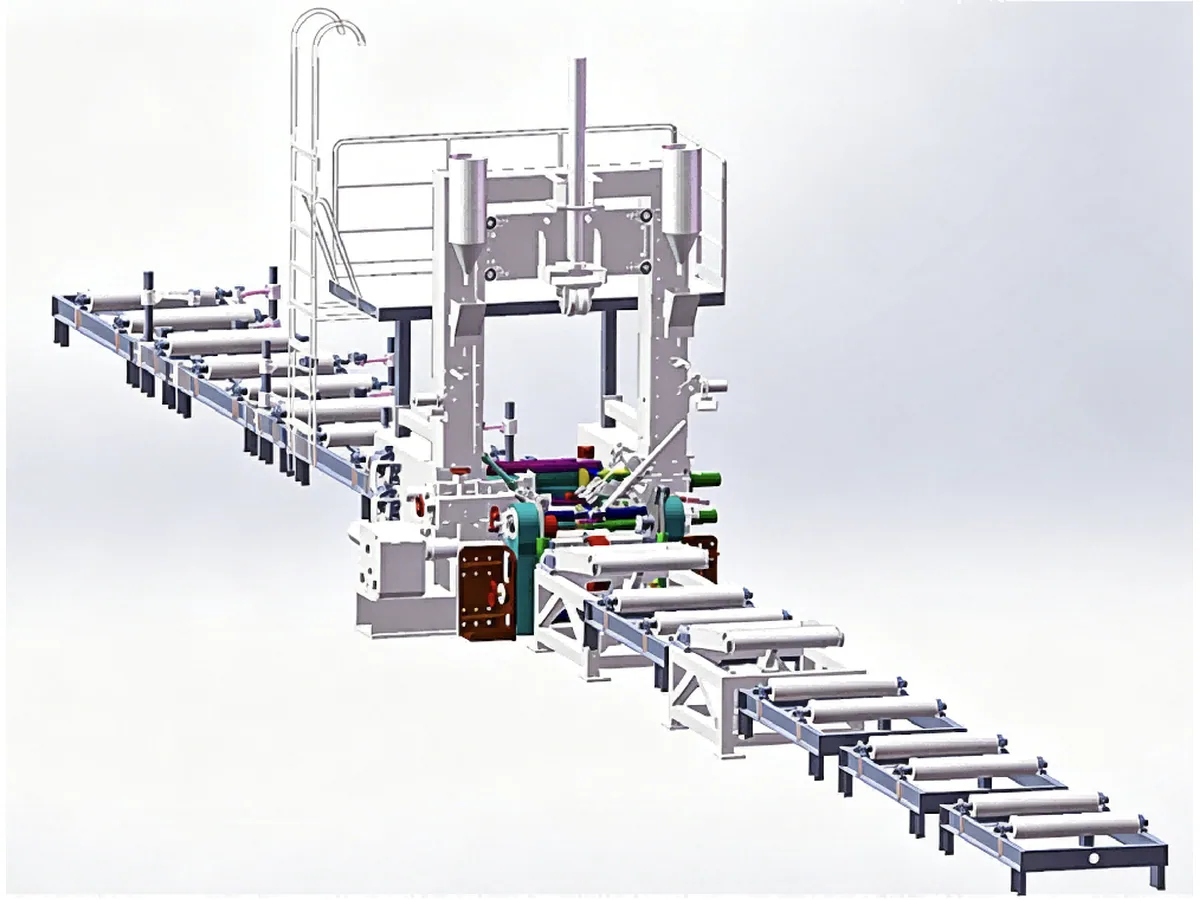
The complete station: in-feed conveyor, gantry press and welding head, then the out-feed conveyor run.


Why one station beats three.
Fit-up, welding and straightening happen in sequence as the beam travels once through the machine. No crane move, no re-clamp, no queue between stations — the handling that normally eats the labour budget disappears.
One station replaces three machines, three foundations and the operators between them. That is floor area you can give to another product line, and labour you can move to fabrication.
Web and flange are hydraulically centred by screw leads and held by the gantry press, so the joint is closed when welding starts rather than relying on fit-up from the previous station.
Hydraulic top rollers press the flange against chain-driven bottom rollers as the beam leaves the weld zone. Straightening follows welding in the same pass, so the beam is not re-handled after cooling.
Welding flux is recovered, cleaned and re-fed by the recovery unit, which keeps the seam covered and cuts flux consumption — the reason a submerged arc station can run continuously rather than in batches.
Light and medium H-beam and T-beam fabrication, where one pass should finish the section.
Power, air, floor length and the crane you provide — plus what ships with the station.
| Voltage | AC 380 V, 3 phase, 50 Hz |
| Connected load | About 2 × 70 kVA welding plus 5.5 kW hydraulic and conveyor motors |
| Compressed air | Clean, dry air for the flux circuit (buyer supply) |
| Welding wire | 3.2 or 4.0 mm, buyer supply per procedure |
| Floor length | Beam length up to 15000 mm plus conveyor run-in and run-out |
| Foundation | Level floor, machine bed on a prepared foundation |
| Lifting | Crane access for loading sections |
| Operator | One operator at the control box for a normal cycle |
What beam fabricators ask before ordering a combined station.
Yes. Centring, clamping, gantry pressing, submerged arc welding, flux recovery and straightening are sequenced in one pass through the station, with one operator at the control box.
Web 150–1500 mm high and 5–25 mm thick, flange 150–800 mm wide and 6–30 mm thick, beam length 4000–15000 mm. Web plate from 14 mm welds soundly but is not fully penetrated — say so on the drawing if full penetration is required.
350–1500 mm/min, set by the wire diameter and the procedure. 3.2 and 4.0 mm wire are both supported by the 70 kVA power sources.
The gantry press closes the web-flange gap before the arc starts and the straightening rollers correct the flange as the beam leaves the weld zone, in the same pass rather than after cooling.
Yes — the same clamping, welding and straightening setup builds T-sections when only one flange is welded.
380 V 3-phase supply for about 2 × 70 kVA welding plus motors, dry compressed air for the flux circuit, welding wire, and floor length for the longest beam plus conveyor run-in and run-out.
A combined station is usually the middle of a beam line — these fit around it.

Full line: end assembly, front and back welding, overturning and conveyors.

Two-station robot cell for precision laser welding of thin-wall parts.

Water-electrolysis hydrogen-oxygen flame unit for brazing and repair work.
Web height and thickness, flange width and thickness, beam length range and metres per shift. An English-speaking engineer replies within one business day with the station layout.