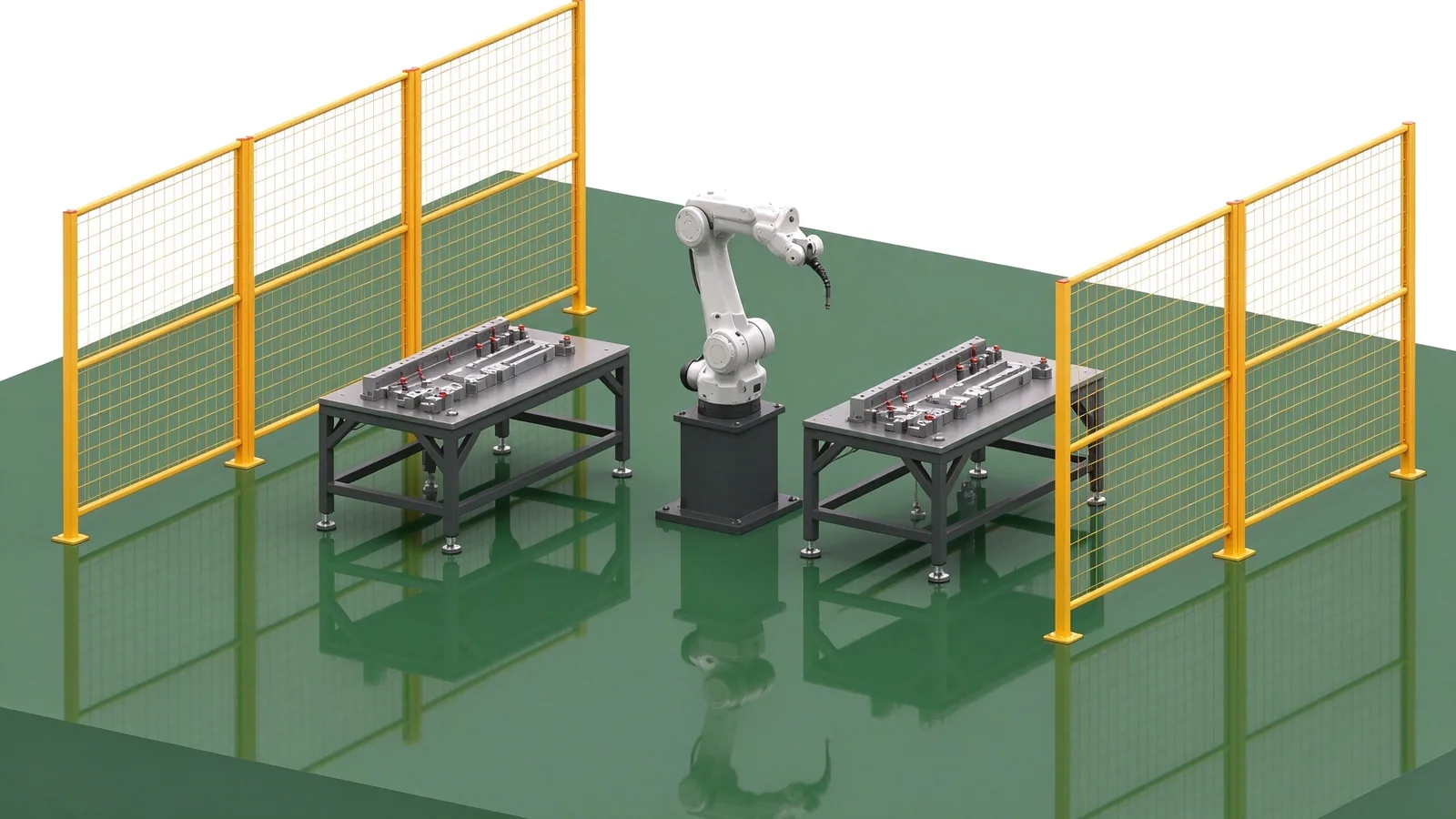
Two stations, one robot: while the operator unloads and re-fixtures at station A, the robot welds at station B. That is the whole economy of the cell — the laser never waits for a human, and the human never waits for the laser. A 2 kW fibre source with switchable beam profiles (Gaussian, ring or hybrid) feeds a scan head that oscillates the beam in X and Y for stir, wobble or spiral patterns, and detects wire break so a bad feed stops the cycle instead of leaving an unwelded seam. Fixtures come from a 3D platform of grid holes and pins, so a new part is built from standard blocks rather than a machined jig.

Part size, filler wire and takt decide whether a two-station cell pays back. Send the part drawing and the joints per shift — we confirm station size, head and fixture set on the proforma invoice.
| Robot axes | 6 |
| Maximum payload | 12 kg |
| Maximum working radius | 2032 mm |
| Repeatability | ±0.05 mm |
| Robot weight | 210 kg |
| Ambient temperature | 0–45 °C |
| Laser source | 2 kW fibre laser with adjustable energy distribution |
| Beam profiles | Gaussian, ring or hybrid, switchable per material and process |
| Welding head | Scan head with X/Y galvanometer, touchscreen parameters, wire-break detection |
| Wire feeding | Automatic, integrated in the laser control system |
| Cooling | Dual-circuit industrial water chiller, one circuit laser, one optics |
| Workstations | 2 × 3500 × 800 mm with support legs |
| Flexible fixture platform | 3D grid-hole platform with standard pins, blocks and quick clamps |
| Control cabinet | Integrated drive and control, 6 axes (12 with external expansion), IP54 |
| Cabinet supply | 1-phase 220 V AC ±10%, 50/60 Hz, rated 3.5 kW |
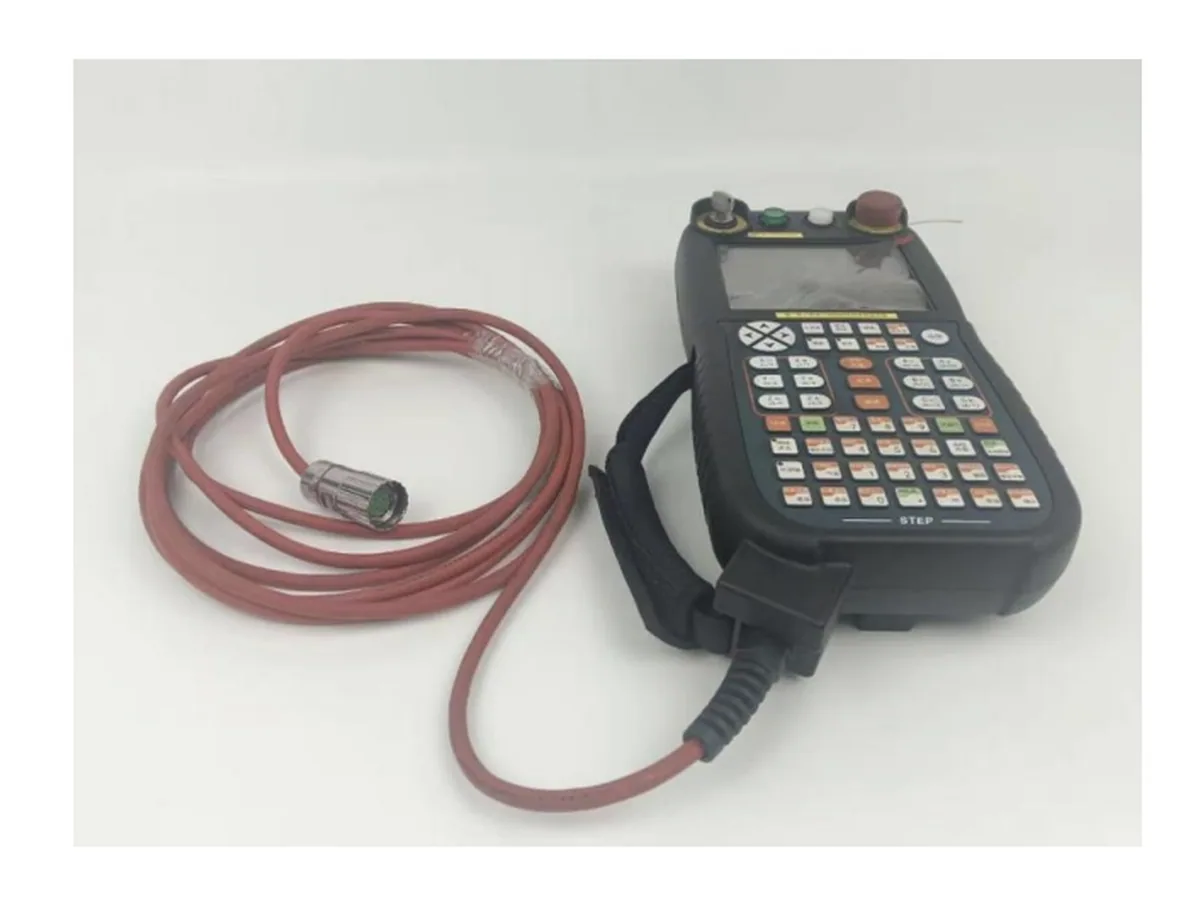
| Teach pendant | 8 in capacitive touchscreen, 18 soft keys plus reset button, 6 m cable (custom lengths available) |
* Specifications as supplied for this model. Final configuration confirmed on the proforma invoice.
Robot, cabinet, pendant, laser kit and station data on one sheet.
Six axes, 12 kg, 2032 mm
| Payload / reach | 12 kg / 2032 mm |
| Repeatability | ±0.05 mm |
| Weight | 210 kg |
| J1 / J2 speed | 160 / 160 °/s |
| J3 speed | 169 °/s |
| J4 / J5 / J6 speed | 300 / 338 / 535 °/s |
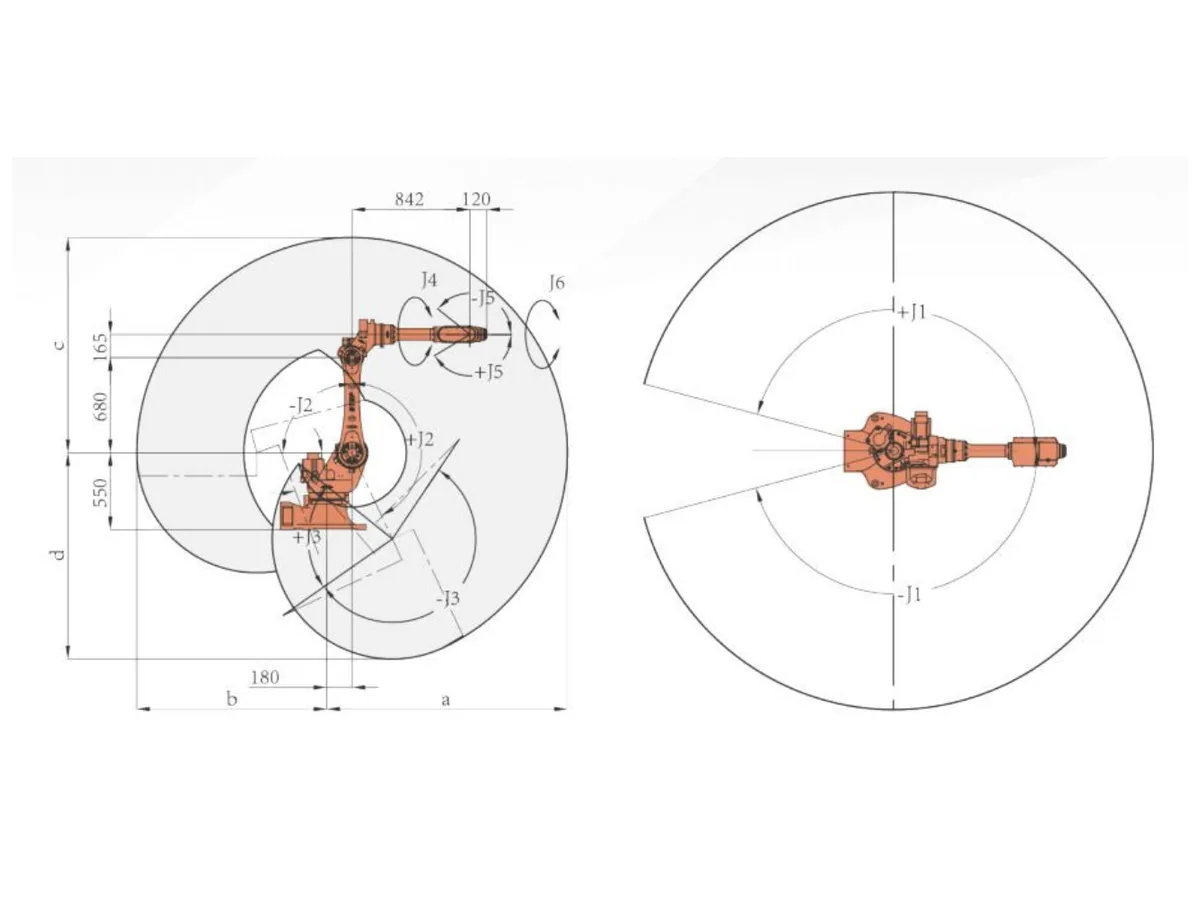
| J1 range | ±165° |
| J2 range | +163° to −80° |
| J3 range | ±80° |
| J4 / J5 / J6 range | ±190° / ±130° / ±220° |
| Wrist torque J4 / J5 / J6 | 11.8 / 9.8 / 4.2 N·m |
| Wrist inertia J4 / J5 / J6 | 0.6 / 0.25 / 0.06 kg·m² |
Drive and control in one unit, IP54
| Axes controlled | 6 standard, 12 with external expansion |
| Dimensions | 420 × 529 × 156 mm |
| Weight | About 18 kg |
| Protection | IP54 |
| Mounting | Horizontal standard, vertical optional |
| Supply | 1-phase 220 V AC ±10%, 50/60 Hz |
| Rated power | 3.5 kW |
| Axis power range | 50 W – 2.7 kW per axis |
| Control hardware | Robot control + motion control + PLC + safety in one unit |
8 in capacitive touchscreen, no physical key switch
| Display | 8 in 4:3 TFT, 1024 × 768 |
| Touch | High-noise-immunity capacitive |
| Keys | 18 soft keys + 1 reset button |
| Dimensions | 296 × 187 × 87 mm |
| Weight | 950 g |
| Cable | Custom length, supplied by the cabinet |
| Language | Bilingual menus, switchable |
2 kW fibre source, scan head, wire feed, chiller
| Laser source | 2 kW fibre with adjustable energy distribution |
| Beam profiles | Gaussian / ring / hybrid, switched by material and process |
| Centre spot | High-peak-power pulsed light |
| Outer ring | High-power continuous wave |
| Welding head | Scan head, touchscreen parameters, X/Y galvanometer oscillation |
| Oscillation patterns | Stir, wobble and spiral welding patterns |
| Wire feed | Automatic, wire-break detection stops the cycle |
| Chiller | Dual circuit, laser and optics cooled independently, distilled water recommended |
Two stations plus a grid-hole platform
| Workstations | 2 × 3500 × 800 mm with support legs |
| Platform | 3D flexible welding platform, standardised grid holes and positioning pins |
| Fixtures | Blocks, supports and quick clamps assembled without custom machining |
| Changeover | Fixture built on the free station while the robot welds the other |
| Suitable work | Small and medium batches, many part variants, thin-wall assemblies |
Working envelope and the teaching pendant that sets the weld path.


The four things that decide cell payback.
Loading and unloading happen at one station while the robot welds the other. Laser-on time is limited by the weld, not by the operator — which is where the payback comes from on a 30-second part.
Gaussian, ring or hybrid profiles, with a pulsed centre spot and a continuous-wave ring, switch per material. Wobble and spiral oscillation from the scan head widen the process window instead of forcing a perfect gap.
A 12 kg payload robot at ±0.05 mm repeatability covers a two-metre working radius — enough for a 3500 mm station worked in two positions, without moving the part.
The 3D platform's grid holes and pins accept standard blocks, supports and quick clamps. A new part is fixtured in minutes without machining a dedicated jig, which is what makes small batches viable.
The welding head detects wire break and the control stops, so a feed problem shows up as a stopped cycle rather than as a seam welded without filler.
Thin-wall and precision parts where arc welding would distort the assembly.
Power, cooling water and floor space for the cell — plus what ships with it.
| Cabinet supply | 1-phase 220 V AC ±10%, 50/60 Hz |
| Laser and chiller supply | Per the laser source and chiller nameplate |
| Cooling | Chiller with distilled water, dual circuit |
| Compressed air | Clean, dry air for clamping if air clamps are used |
| Shielding gas | Argon or nitrogen per procedure, regulator by the buyer |
| Floor | Level floor for two 3500 × 800 mm stations plus robot base |
| Fencing | Safety fence and interlock advised around the cell envelope |
| Environment | 0–45 °C, keep the cabinet clear of dust and water spray |
What buyers ask before committing to a two-station laser cell.
Yes — that is the point of two stations. While one station is being unloaded and re-fixtured, the robot welds the other, so laser utilisation is set by the weld cycle rather than by handling.
A 2032 mm working radius and stations of 3500 × 800 mm. Parts are worked in two positions within the station, and the 12 kg payload covers fixtures plus the head.
The head supports wire feeding with wire-break detection, so both autogenous and filler-wire welds are possible. Which one applies depends on joint fit-up and material thickness.
Gaussian, ring and hybrid, switchable from the laser source, with the scan head adding stir, wobble or spiral oscillation. That combination lets you trade penetration against gap tolerance.
Single-phase 220 V for the control cabinet, plus the laser and chiller supply per their nameplates. Cooling is water, through the dual-circuit chiller.
Fixtures come from the grid-hole platform: blocks, supports and quick clamps are placed on the pins, no machining. A new part is typically fixtured while the other station runs.
A laser cell usually sits beside an arc cell and a cutting machine.

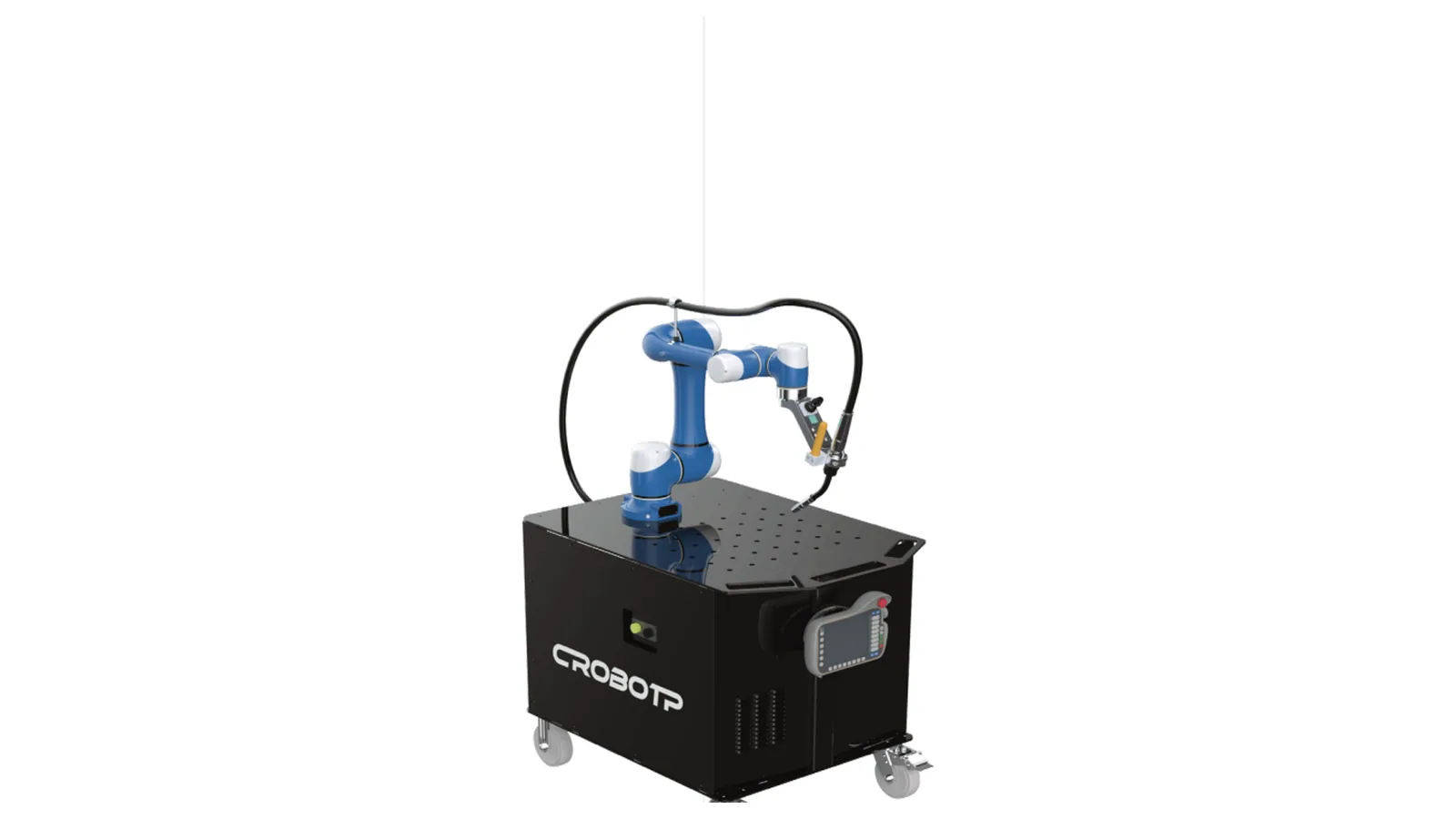
Drag-to-teach 6-axis cobot for flexible small-batch welding.

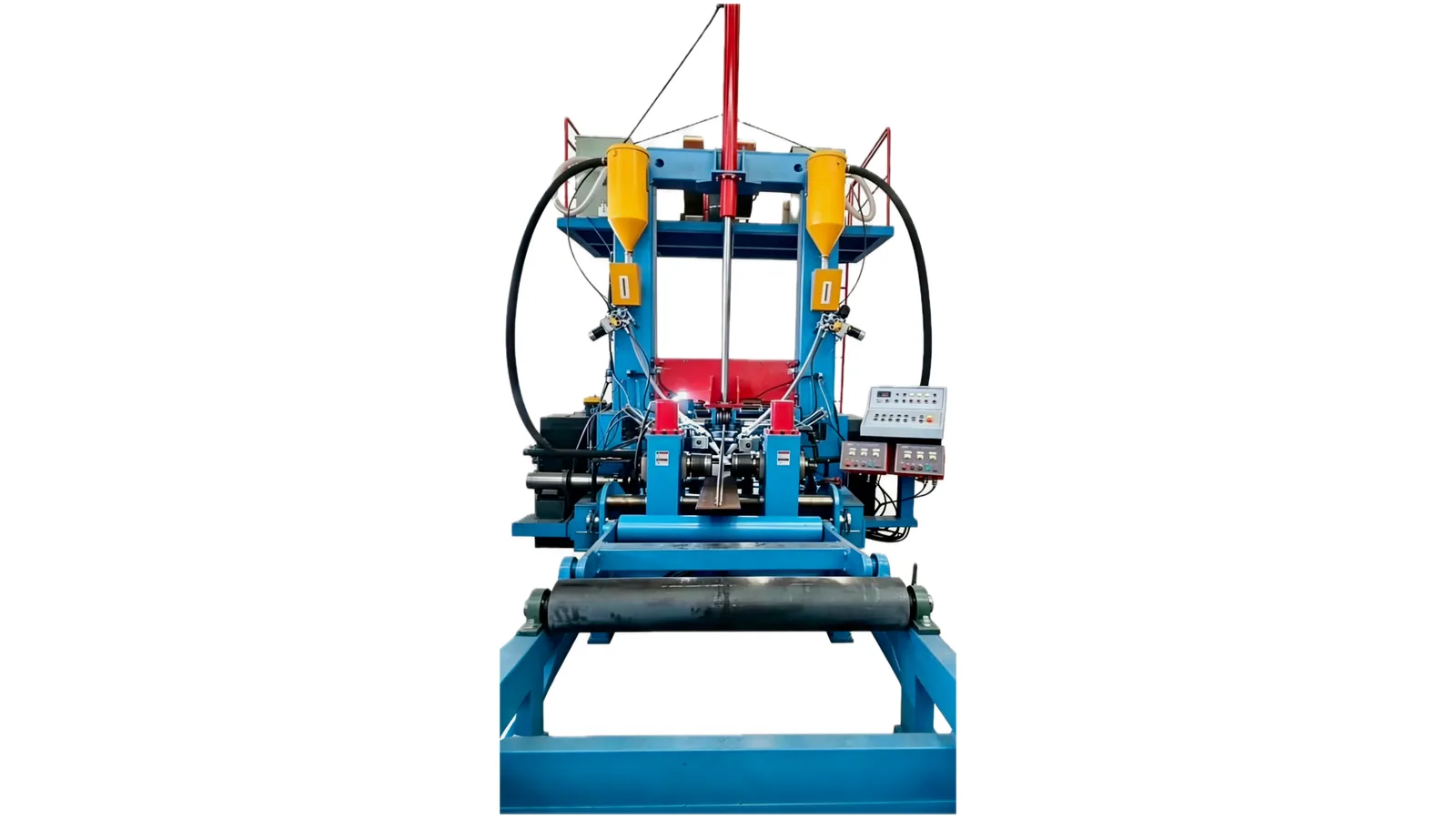
Fit-up, submerged arc welding and straightening in one pass.

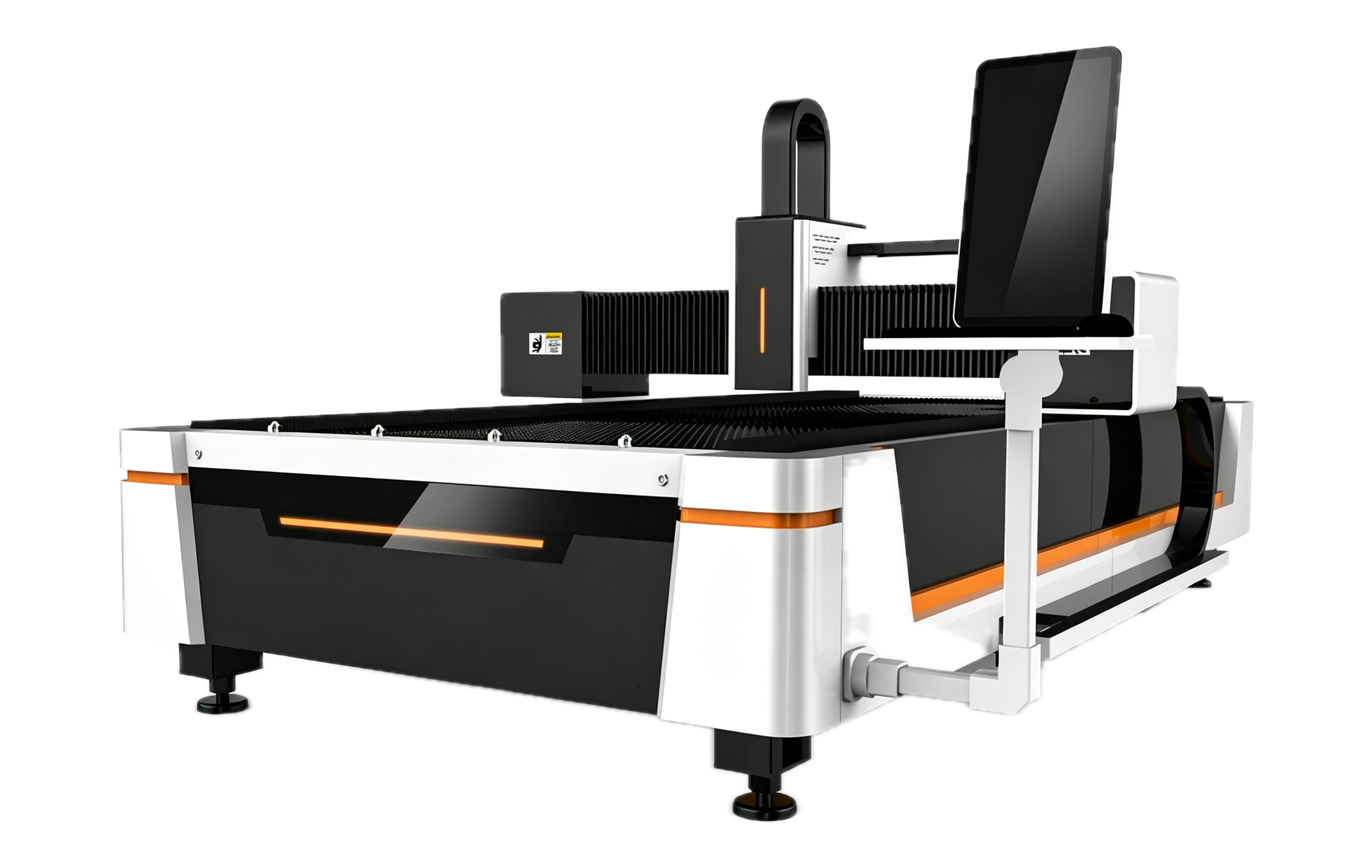
Cuts the blanks this cell welds, in the same shop.
Part size and thickness, filler wire or autogenous, joints per part and parts per shift. An English-speaking engineer replies within one business day with cell layout and fixture proposal.