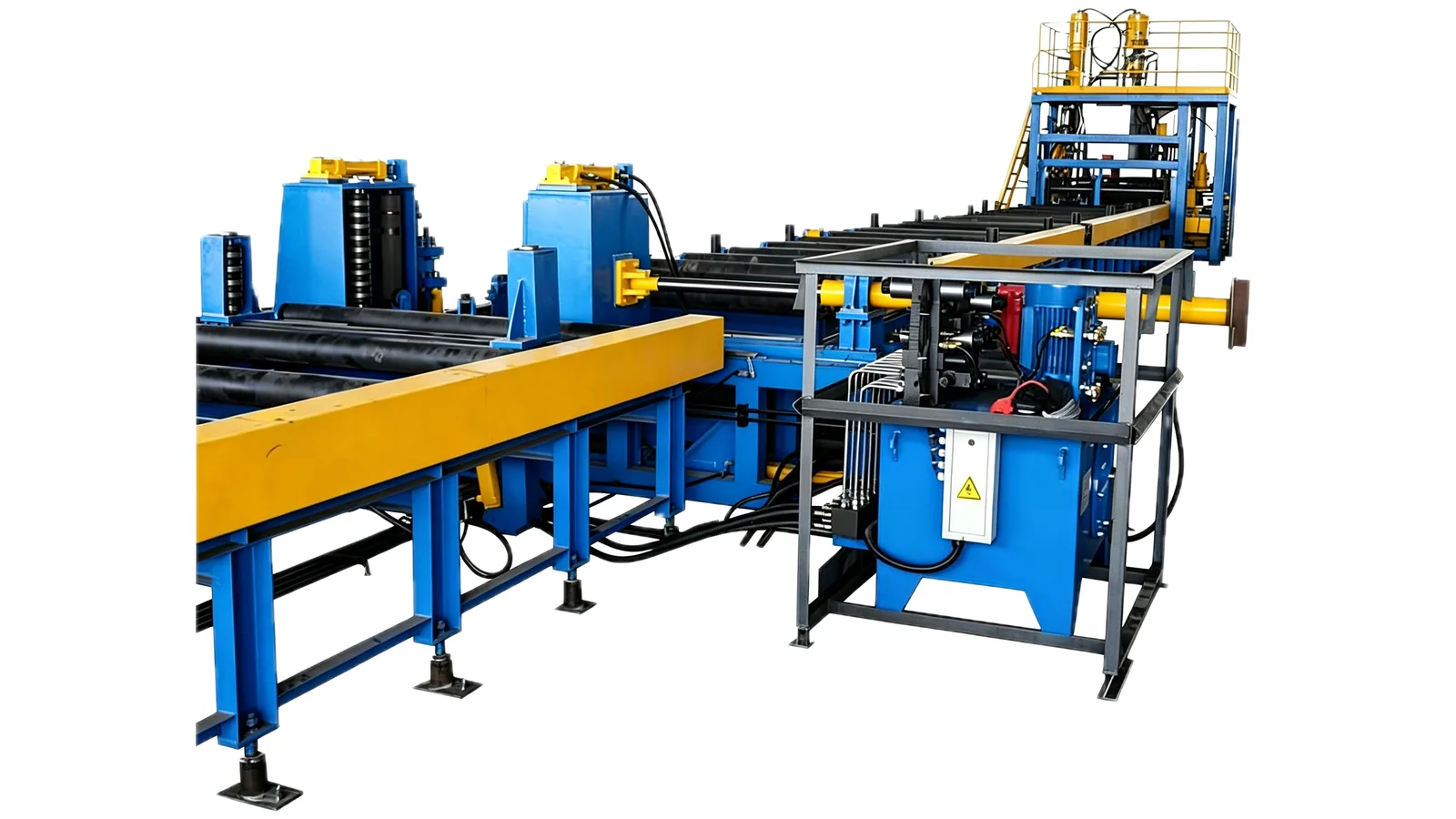
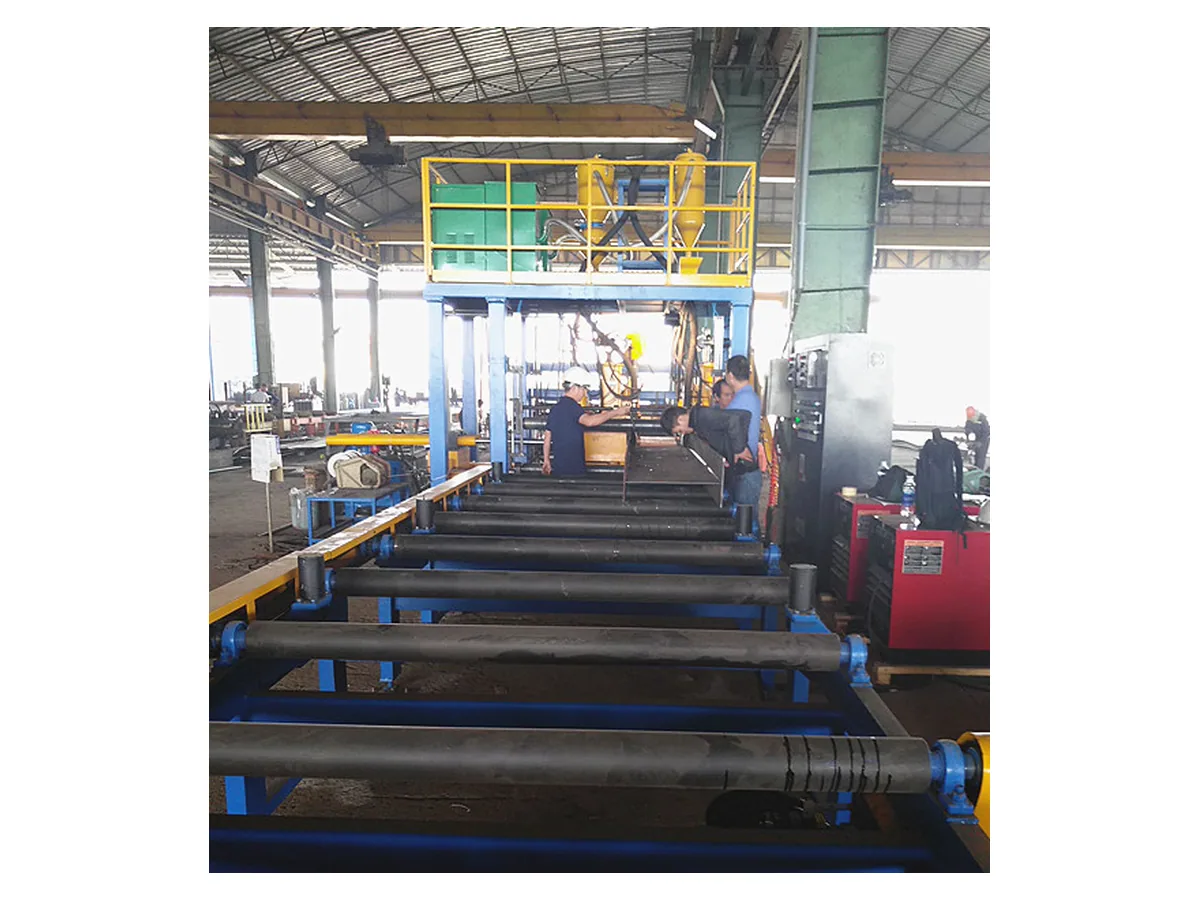
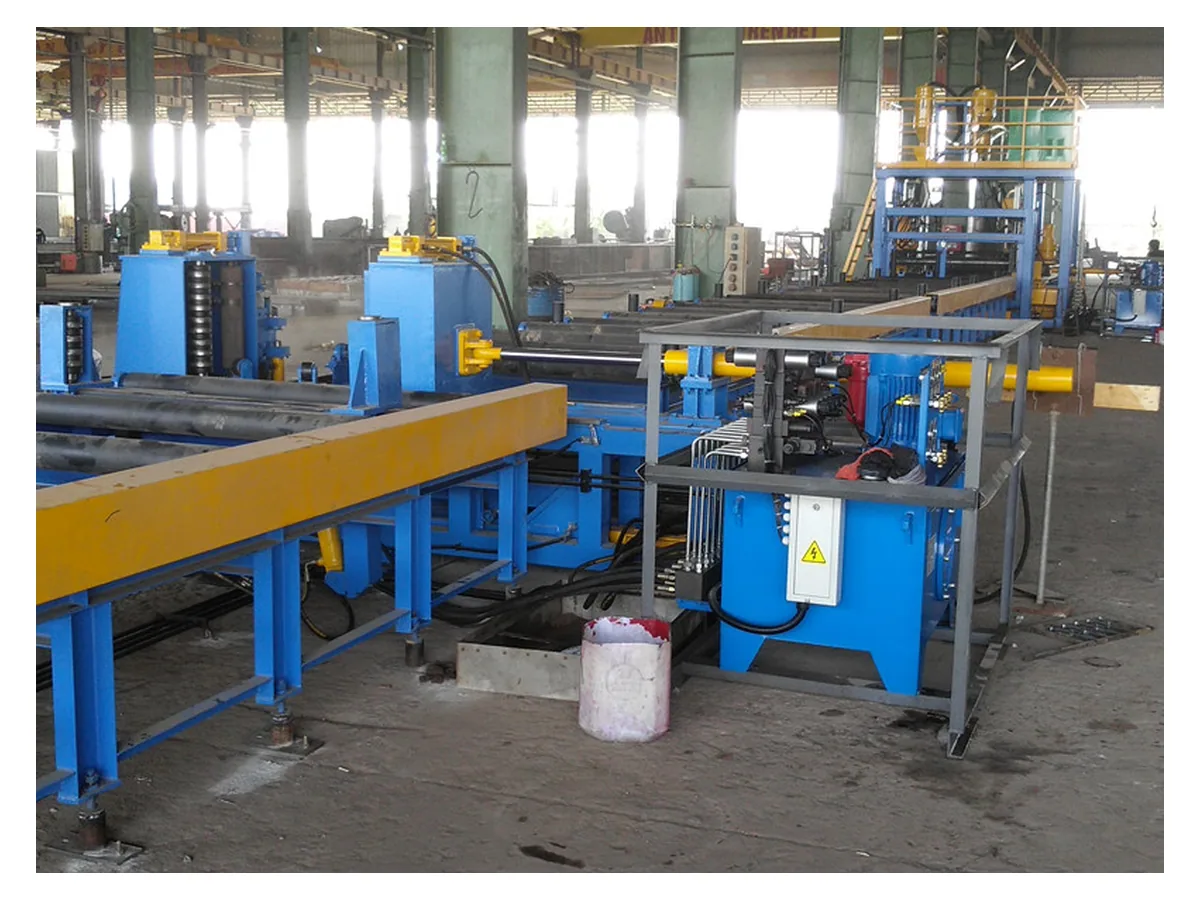
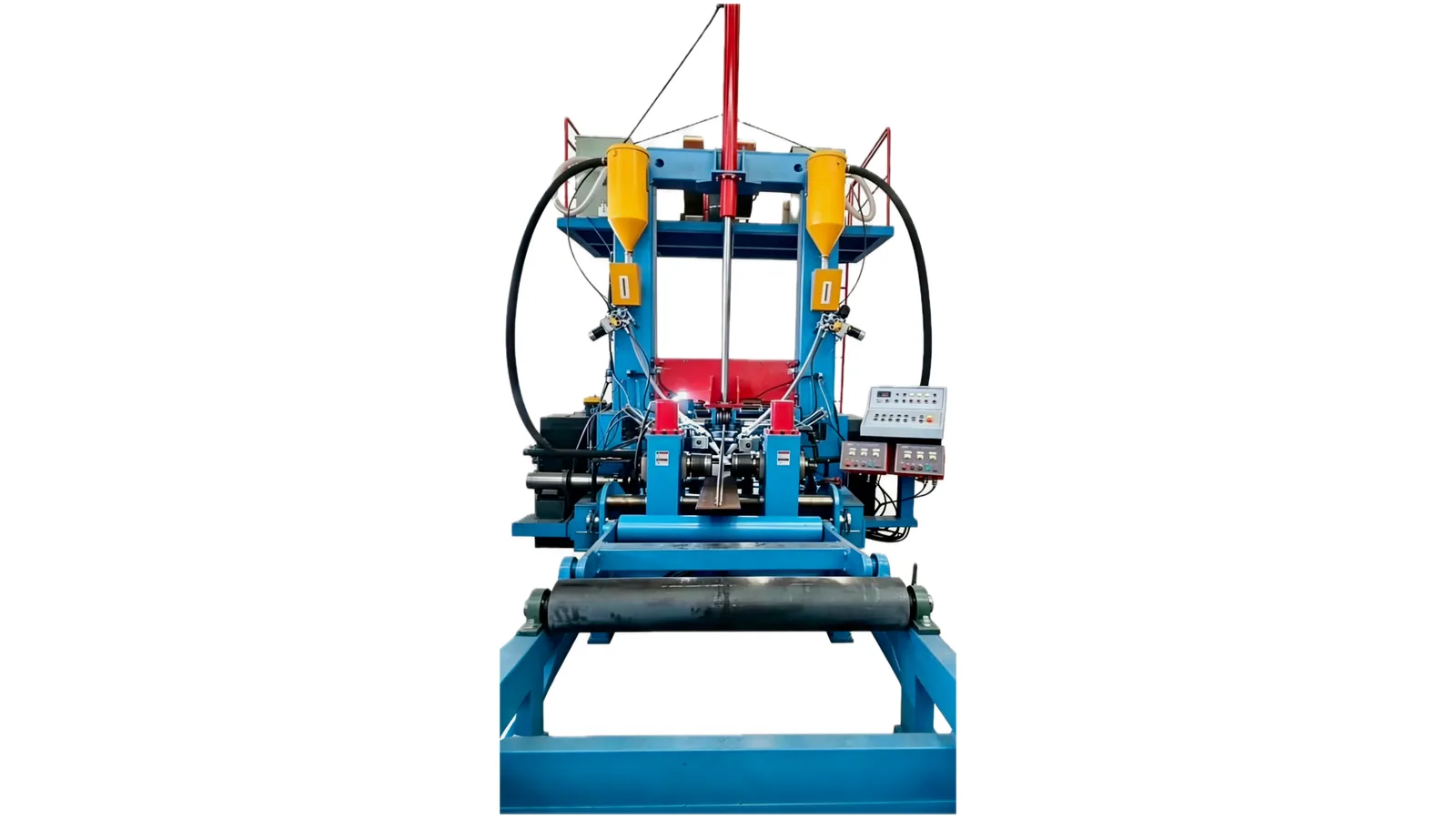
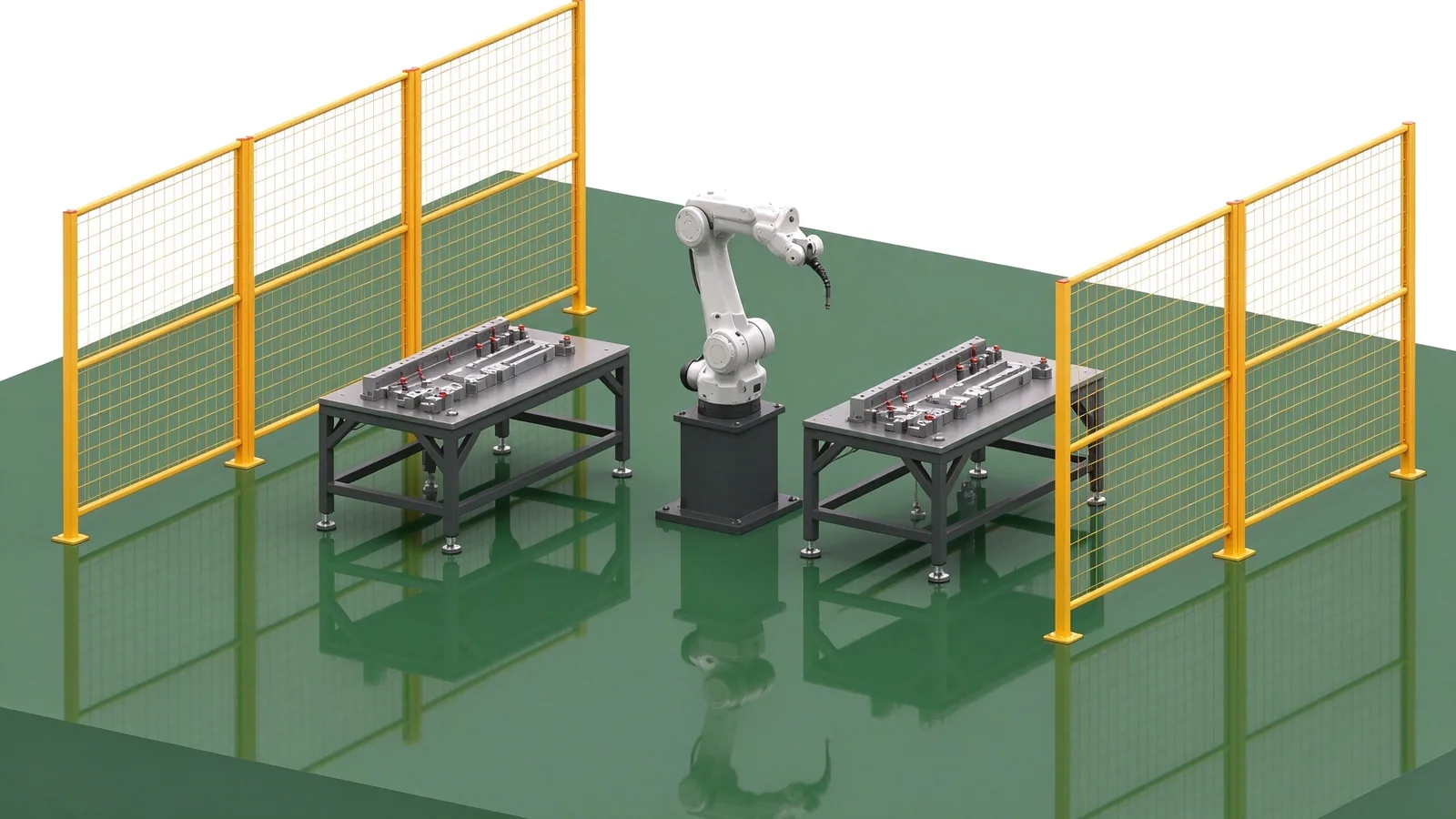
Instead of assembling a T-section and then welding it into an H, this line lays the beam on its side: web flat, flanges vertical, workpiece moving past the torch. Two seams weld at once in that position, which is why a horizontal line produces less deformation than a vertical one — the heat is balanced across the section instead of stacked. Tip the beam 180° and the other two seams go down the back welding machine. Assembly at the end is only a tack weld, not a full seam, so the line stays short: end assembly, front weld, turnover, back weld, conveyors. Four to five operators run the whole line.

Section range and output per shift decide the line length. Send the beam schedule and the metres per day — we confirm conveyor runs, number of stations and whether a half line is enough.
| Web height | 300–1500 mm |
| Web thickness | 5–12 mm |
| Flange width | 150–500 mm |
| Flange thickness | 5–20 mm |
| Suitable workpiece length | 4000–15000 mm |
| Workpiece maximum weight | 4000 kg |
| Welding speed | 0.3–1.9 m/min |
| Cross-section drift angle | ≤ 8° |
| Welding method | Single arc twin wire submerged arc |
| Welding wire diameter | 1.6 mm |
| Typical welding speed at 1.6 mm wire | About 1.2 m/min |
| Line composition | End assembling machine, front welding machine, overturning machine, back welding machine, conveyors |
| Half line | Assembling machine + front welding machine only |
| Operators | 4–5 for the whole line |
| Conveyor speed | 9.3 m/min |
| Overturning capacity | ≤ 5 t, 180° in two 90° steps |
* Specifications as supplied for this model. Final configuration confirmed on the proforma invoice.
Work-piece range, then each machine in the line with its own drives and supply range.
Light and medium H-beams
| Web height | 300–1500 mm |
| Web thickness | 5–12 mm |
| Flange width | 150–500 mm |
| Flange thickness | 5–20 mm |
| Length | 4000–15000 mm |
| Maximum weight | 4000 kg |
| Drift angle | ≤ 8° |
| Position | Web horizontal, flanges vertical, workpiece moving |
Tack weld at the end, no full seam
| Function | Assemble the three plates into an H and tack weld at the end |
| Conveying speed | 9.3 m/min |
| Roller motors | 0.75 kW × 2 |
| Hydraulic motor | 5.5 kW |
| Conveyor | 3.4 m × 4 sets |
| Side overturning | Front and back frames with magnetic wheels |
| Axes | Web elevator, end alignment, conveying drive, all hydraulic |
| Manual | Spot welding and CO₂ welder by the buyer |
Twin-wire SAW on the first two seams
| Welding speed | 0.3–1.9 m/min |
| Welding method | Single arc twin wire |
| Wire diameter | 1.6 mm |
| Conveyor | 3.4 m × 8 sets, 9.3 m/min |
| Main motor | 0.55 kW |
| Roller motors | 0.75 kW × 4 |
| Hydraulic station | 5.5 kW |
| Flux recovery | 3 kW × 2, two recovery machines |
| Power sources | 2 submerged arc welders with controllers and wire feeders |
| Assistant positioner | 1 set, lifts and clamps the beam during in-feed |
180° in two 90° steps
| Capacity | ≤ 5 t |
| Arms | One set, three pieces |
| Hydraulic station | 15 kW, 16 MPa working pressure |
| Motion | Front frame 90°, back frame 90°, conveyor moves the beam to the back welder |
The other two seams, same torch setup
| Welding speed | 0.3–1.9 m/min |
| Welding method | Single arc twin wire |
| Conveyor | 3.4 m × 8 sets, 9.3 m/min |
| Main motor | 0.55 kW |
| Roller motors | 0.75 kW × 4 |
| Hydraulic station | 5.5 kW |
| Flux recovery | 3 kW × 2 |
| Power sources | 2 submerged arc welders with wire feeders |
| Difference to front machine | No pre-clamp positioner; the assembled beam is already closed |
One hydraulic and electrical system per station
| Conveyor speed | 9.3 m/min for transport |
| Roller sets | 3.4 m modules, counts per station |
| Control | Individual control box per machine |
| Hydraulics | Separate pump station per station, 16 MPa on the turnover |
| Line crew | 4–5 operators, spot welding at the front end |
On-site views of the end assembling machine and the line in production.


Why horizontal beats the classic vertical line on light beams.
With the web flat and flanges vertical, both seams are in position for one gantry pass. Two arcs on opposite sides balance the heat, so the section does not pull itself out of shape the way a single-side vertical weld does.
Only the end is spot welded before the beam goes to the welder. The machine then clamps and positions the three plates and lays the real seams — assembly time drops because the operator is not welding the whole joint twice.
Defined for webs 5–12 mm, this line is aimed at light-duty beams where a vertical line's deformation would need correction afterwards. The drift angle is held within 8°.
Assembly, two welding stations, turnover and conveying are laid out as one flow. The line crew stays at four to five, against the larger crew a three-station vertical layout needs.
The turnover station flips the beam 180° in two steps and the conveyor feeds it straight into the back welder — no crane, no re-fixture, no second fit-up.
Light and medium structural beams produced in a flow rather than at benches.
Power, air, floor length and crane — plus what ships with the line.
| Power | Per station: welding power sources plus motors, 380 V 3-phase |
| Compressed air | Clean, dry air for clamping and flux circuit |
| Welding wire | 1.6 mm, buyer supply per procedure |
| Floor length | Station modules on 3.4 m conveyor runs, sized to 15000 mm beams |
| Foundation | Prepared foundations under each station before installation |
| Lifting | Crane access to load plates and remove finished beams |
| Line crew | 4–5 operators |
| Flux | Welding flux per procedure, recovered and re-fed |
What fabricators weigh before choosing a horizontal line.
Welding with the web flat puts both seams in position for one pass and balances the heat across the section, so deformation is lower. It also lets assembly be a tack weld at the end instead of a full seam, which shortens the line and the labour.
Web 300–1500 mm high and 5–12 mm thick, flange 150–500 mm wide and 5–20 mm thick, lengths 4000–15000 mm, up to 4000 kg per workpiece.
0.3–1.9 m/min. At 1.6 mm wire the typical setting is about 1.2 m/min twin-wire, which gives a sound seam with a clean appearance.
Four to five for the complete line — assembly, front welding, turnover, back welding and conveying as one flow.
Yes. A half line is assembling machine plus front welding machine, for shops that weld the remaining seams on another machine or by hand.
Yes — each station needs a prepared foundation, and the buyer completes the machine foundations in advance of installation.
The line is the spine; these machines feed or finish it.

One station for fit-up, welding and straightening when floor space is tight.

Laser cell for thin-wall sub-assemblies on the same shop floor.

Cuts the web and flange plates that feed this line.
Section sizes, lengths, metres per shift and the floor length available. An English-speaking engineer replies within one business day with line layout and station counts.