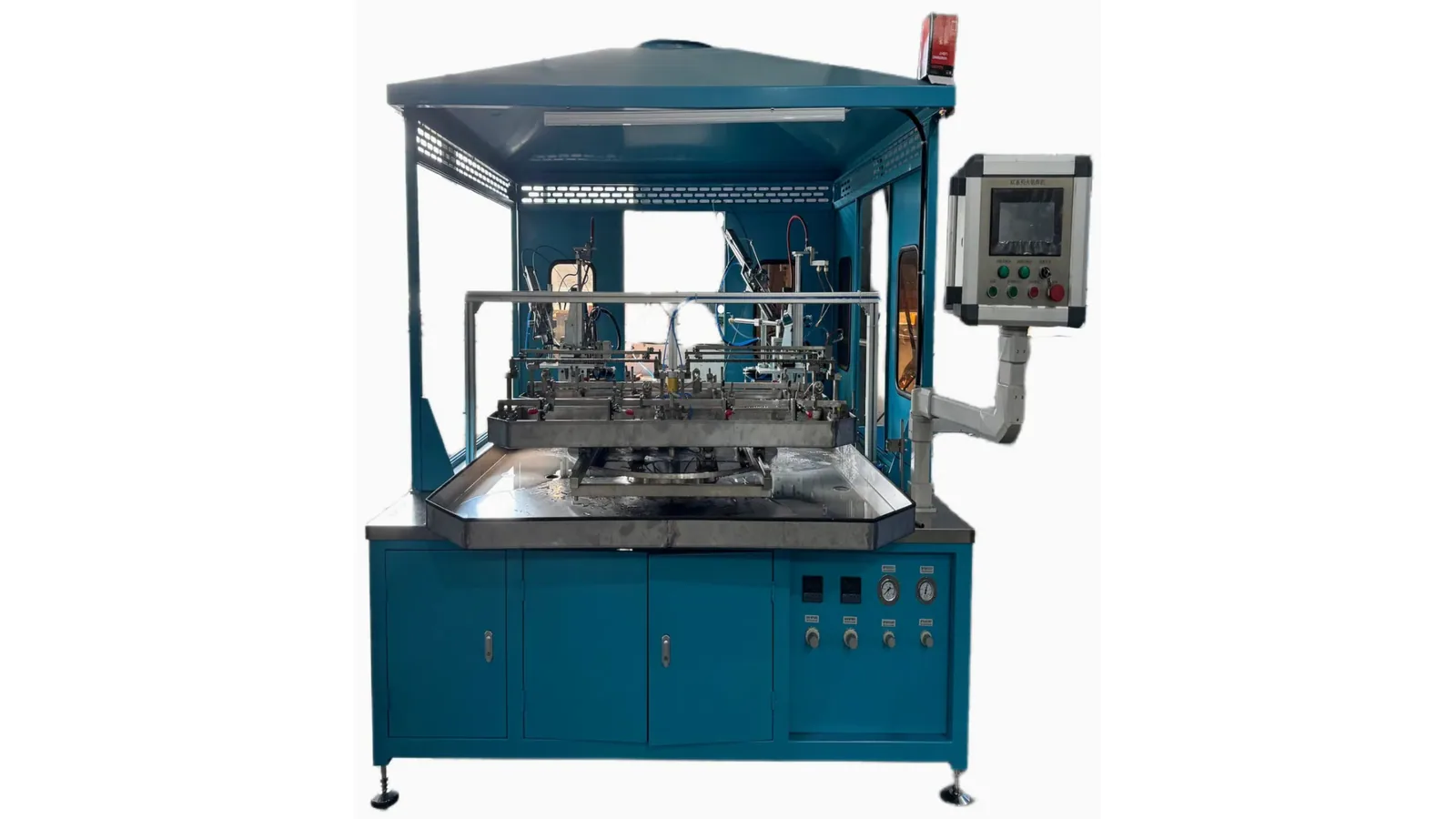
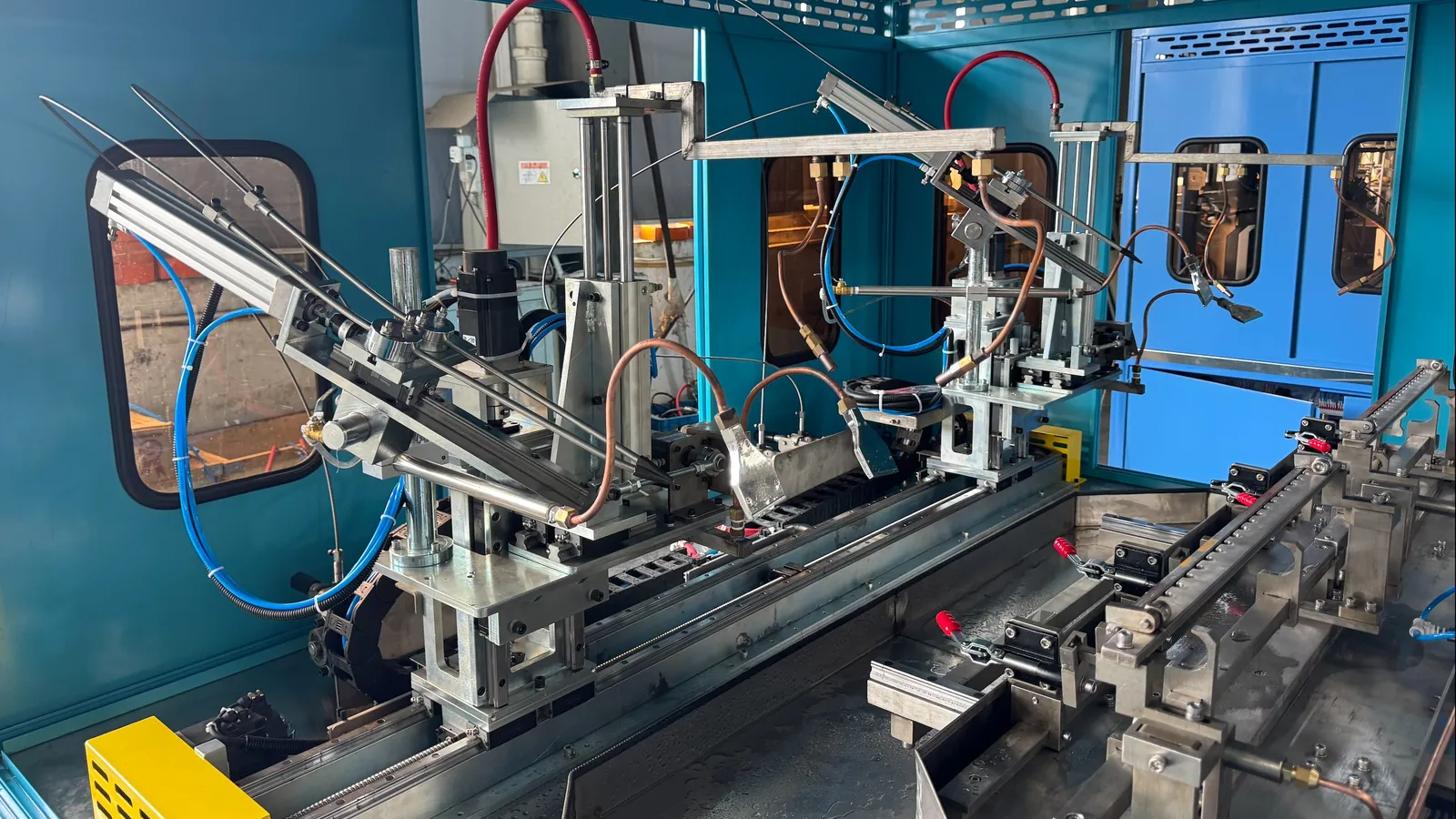
For mass production of copper manifolds, flame brazing is the fast route — and this machine turns it into a rotary process. Fixtures ride a graduated turntable past heating, brazing and cooling stations; the operator only loads and unloads. Two flame brazing systems with two automatic wire feeders work the joints from opposite sides, torches adjust in every direction for different manifold sizes, and gas pressure, flow and heating time are preset in the controller instead of set by hand. Stainless fixtures hold the parts without deforming at brazing temperature, and stations detect whether a part is present before they fire.

Cycle time, fixture count and gas figures decide whether this rotary brazing machine fits your manifold family. Send us the manifold drawing and pieces per shift — we confirm the fixture layout and station count on the proforma invoice.
| Applicable parts | Copper and brass tube brazing — copper manifolds, distributor assemblies |
| Productivity | 30 seconds per cycle |
| Welding torch stretching cylinder stroke | 175 mm |
| Welding torch swinging range | 5–10 mm |
| Electric supply | 380 V, 3 phase, 50 / 60 Hz |
| Motor power | 1.5 kW |
| LPG or CNG pressure required | 0.065–0.12 MPa |
| Compressed air pressure required | 0.5–0.55 MPa |
| Machine dimensions | About 2700 × 2900 × 2600 mm |
| Weight | About 1500 kg |
| Pipe fixtures | 4 sets, stainless steel |
| Flame systems | 2 sets, each with an automatic wire feeder |
| Control | PLC + touch screen, gas pressure / flow / heating time preset |
| Cooling | Water cooling system; compressed-air cooling at the cool-down station |
* Specifications as supplied for this model. Final configuration confirmed on the proforma invoice.
Full data on the rotary table, the two flame systems, gas supply and the safety chain.
Graduated rotary table with heating, brazing and cooling stations
| Table type | Graduated turntable, index-driven |
| Stations | Load, heat, braze, cool, unload |
| Fixture count | 4 sets of pipe fixtures |
| Fixture material | Stainless steel, deformation-free at brazing temperature |
| Part detection | Heating and cooling stations auto-detect a part before firing |
| Operator work | Manual loading and unloading only; all other actions automatic |
Two torch sets with two automatic wire feeders
| Flame systems | 2 sets |
| Wire feeders | 2 sets, automatic |
| Torch stretch stroke | 175 mm cylinder stroke |
| Torch swing range | 5–10 mm |
| Torch adjustment | Fine adjustment in all directions for different part sizes |
| Gas control | Intelligent controller presets gas pressure, flow and heating time |
| Fuel gas | LPG or CNG, 0.065–0.12 MPa at point of use |
Nitrogen outfiring, water cooling, smoke exhaust
| Nitrogen | Outfiring through the joint, quick and reliable |
| Cooling | Water cooling system plus air cooling at the cool-down station |
| Smoke exhaust | Dedicated smoke exhausting system on the hood |
| Protection cover | Hood over the brazing zone with exhaust vent at the top |
Mitsubishi PLC and HMI, Schneider switchgear, Omron sensors
| PLC & HMI | Mitsubishi (Japan) |
| Main pneumatic components | SMC (Japan) |
| Phototube switches | Omron (Japan) |
| Linear guide | PHI (Taiwan) |
| Gas controller | AVENTIC (Germany) |
| Main electrics & buttons | Schneider |
| Recipes | Gas pressure, flow and heating time preset and recalled from the HMI |
Complete safety and alarming with automatic gas shut-off
| Alarm chain | Complete safety and alarming on the machine |
| Gas shut-off | Automatic gas supply stop on fault or missing part |
| Hood | Protective cover over the brazing zone, exhaust at the top |
| Compressed air | 0.5–0.55 MPa at point of use; regulator by the user if outside range |
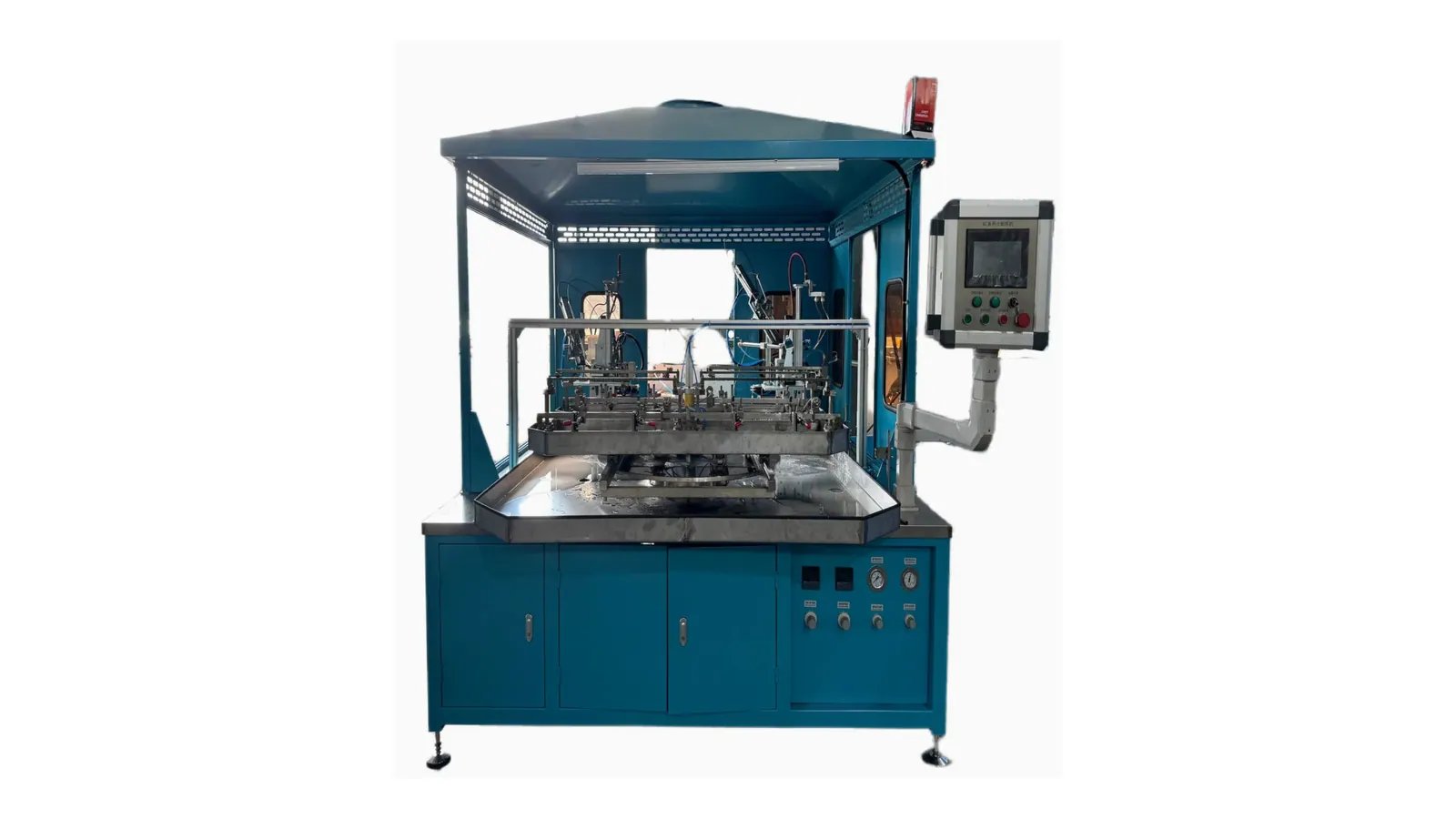
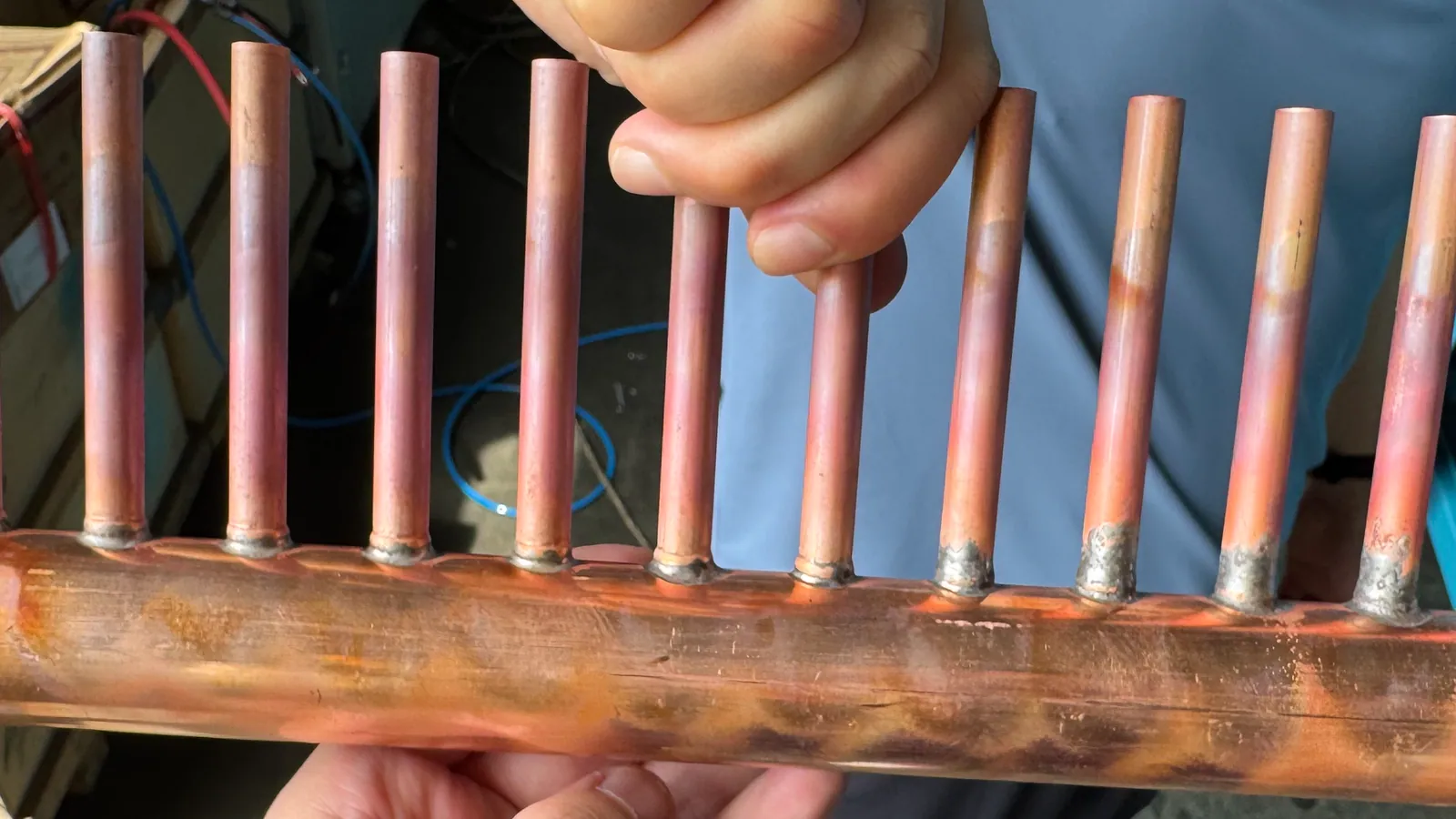
The machine as built — hood, rotary fixture table, brazing interior and a finished copper manifold.


What a rotary brazing layout buys you on a manifold line.
Fixtures index through heat, braze and cool on their own. The operator's job shrinks to placing and removing parts, which is the only way a flame process reaches a 30-second cycle without a second person at the torch.
Two flame systems with two automatic wire feeders braze from both sides of the joint. Fill is fed, not dipped, so the amount of alloy per joint stays the same part to part.
Cycle time is set by the table index and the preset heating time, not by how fast an operator can judge the flame colour. The same recipe runs the same manifold all shift.
Stainless fixtures hold the part at brazing temperature without deforming, and nitrogen outfiring protects the bore so the manifold does not scale up internally.
Heating and cooling stations detect the part before they fire, and the safety chain cuts gas automatically — which is what makes an unattended rotary flame process acceptable in a production shop.
Rotary flame brazing is used where manifolds and distributor assemblies are made in volume.
Gas, air, water and floor space you provide — and what ships with the machine.
| Electric supply | 380 V · 3 phase · 50 / 60 Hz |
| Motor power | 1.5 kW |
| LPG or CNG | 0.065–0.12 MPa at point of use |
| Compressed air | 0.5–0.55 MPa at point of use |
| Cooling water | Circulating water for the cooling station |
| Floor space | About 2700 × 2900 × 2600 mm, level floor |
| Machine weight | About 1500 kg |
| Smoke exhaust | Duct from the hood exhaust by the buyer |
The points manifold shops raise before ordering a rotary brazing machine.
Copper and brass tube assemblies — copper manifolds, distributor headers and similar parts where several branch tubes join one body. Send the drawing and we confirm fixture layout and whether one index cycle covers all joints.
One part per 30-second cycle on the quoted configuration. That figure assumes the joints fall within the torch swing range of 5–10 mm and the 175 mm torch stretch stroke; a taller manifold may need a second heating position.
No flame judgement is required. Gas pressure, flow and heating time are preset in the controller and recalled per part number, and the stations fire only when a part is detected. Loading and unloading are the manual steps.
Nitrogen outfiring through the joint during brazing, plus preset heating time so the part is not overheated. That keeps the internal passage clean without a post-braze pickling step.
LPG or CNG at 0.065–0.12 MPa and compressed air at 0.5–0.55 MPa at the points of use, plus cooling water and an exhaust duct from the hood.
Fixtures are stainless steel sets, one per manifold family. Changing family is a fixture swap on the table, not a machine rebuild — tell us the families you run and we quote the sets with the machine.
A rotary brazing machine usually sits next to one of these on a coil or manifold line.

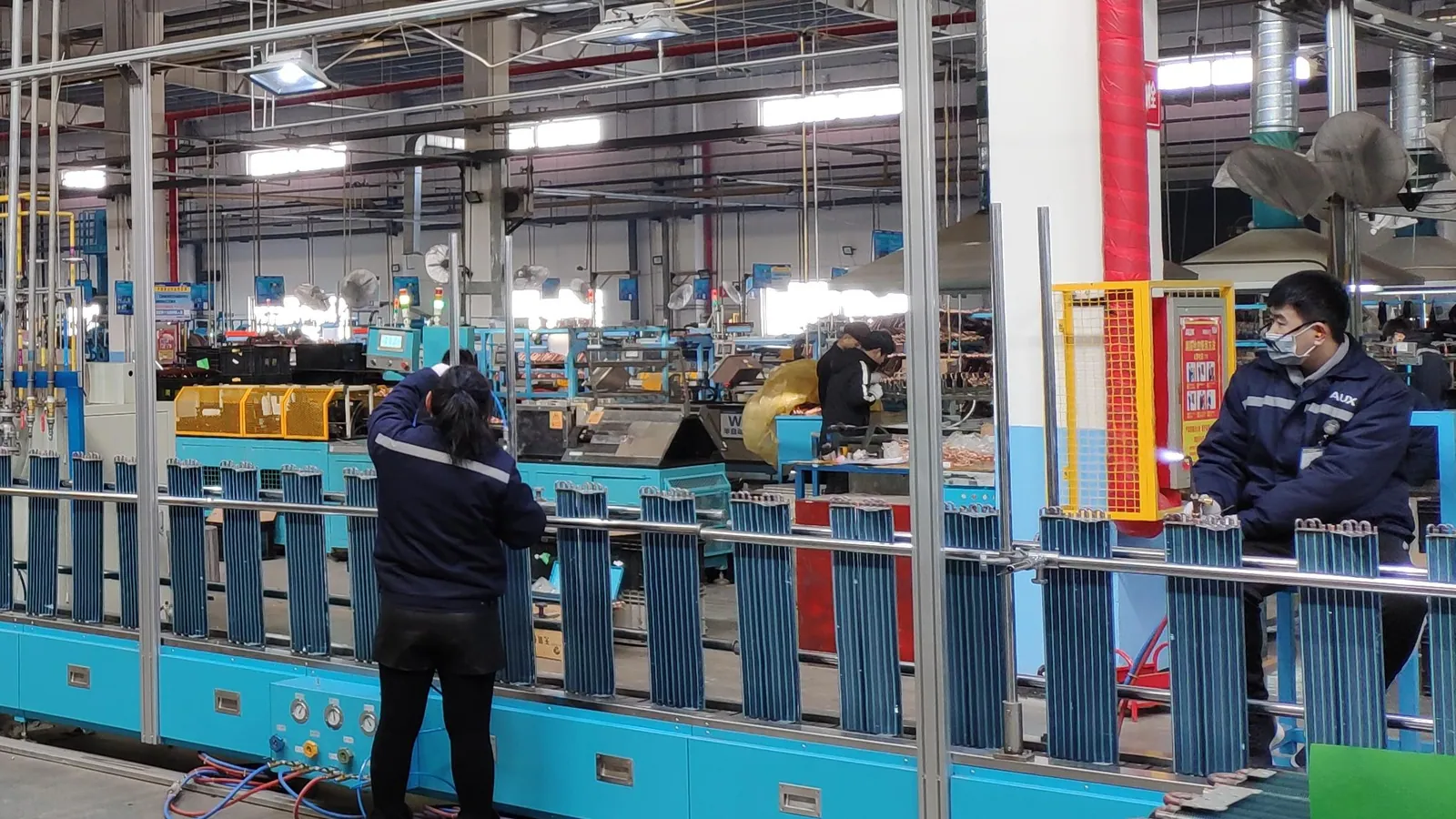
15 m conveyor brazing line for coil return bends, feeding the same coil shop.

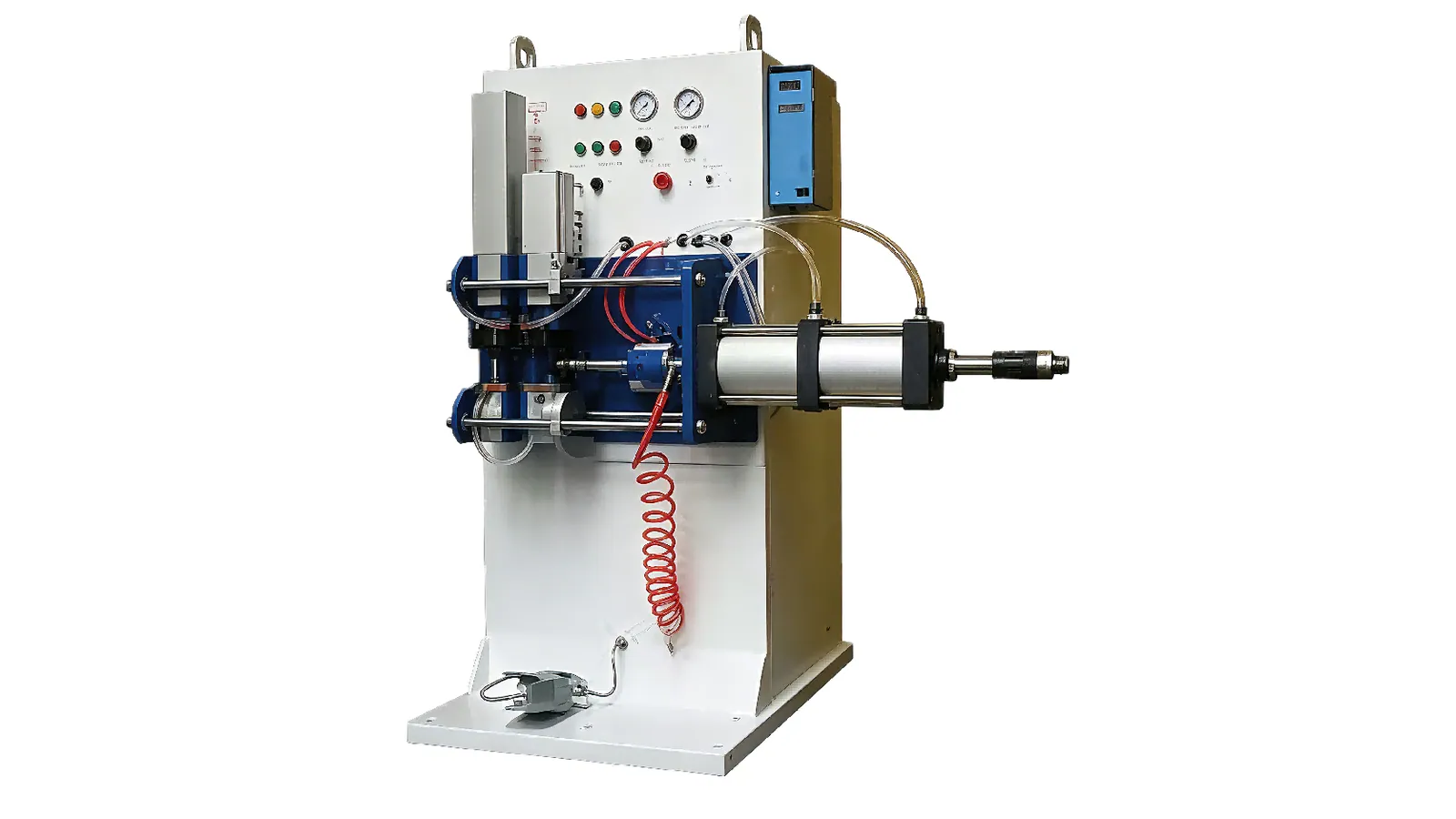
Flash butt welding of copper to aluminium tube at φ6.0–9.52 mm.

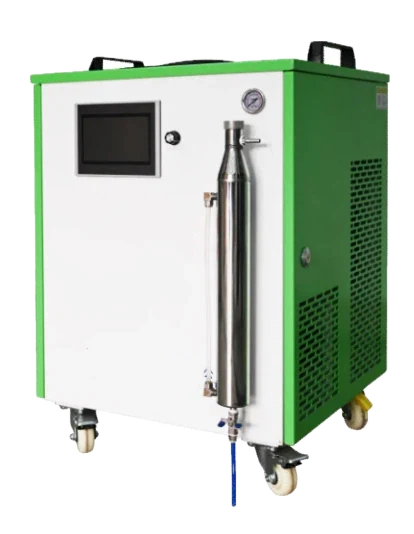
On-site hydrogen-oxygen flame unit for small copper joints and repair work.
Manifold family, branch tube diameters, joints per part and pieces per shift. An English-speaking engineer replies within one business day with fixture layout and cycle estimate.